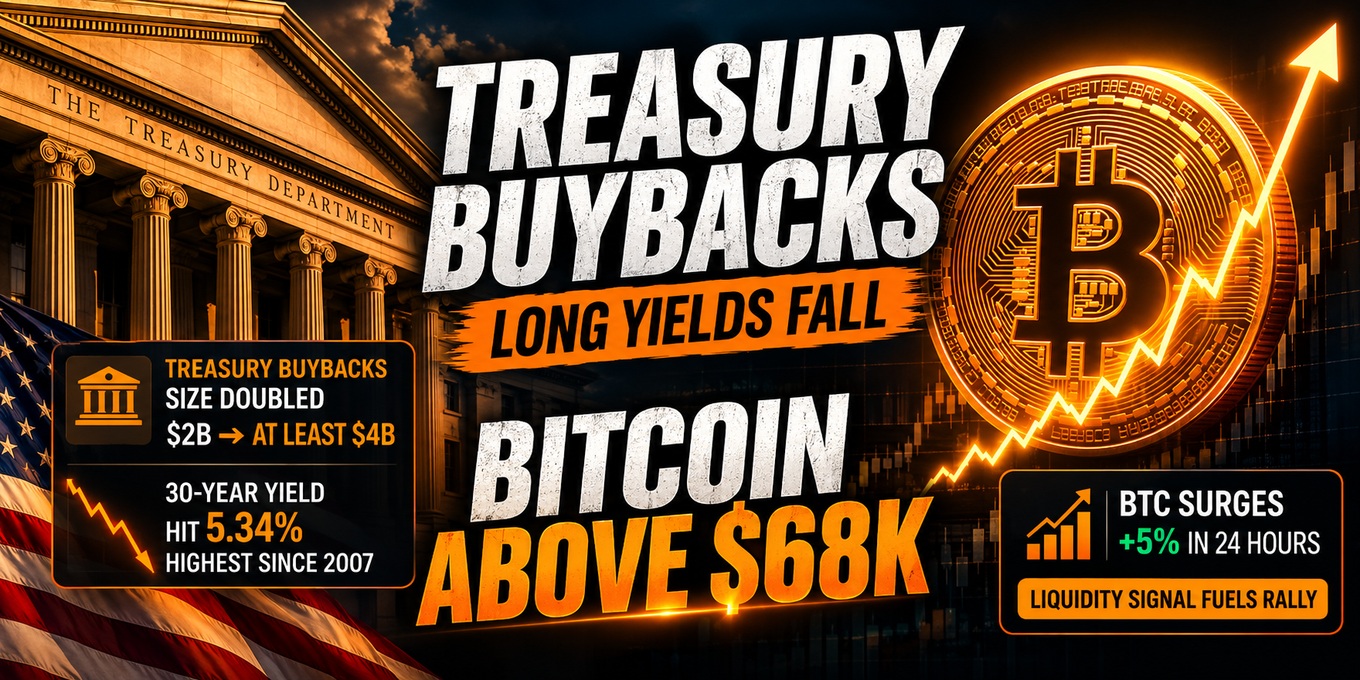
Bitcoin jumped more than 5% in the past 24 hours on Wednesday, breaking above $68,000 and approaching $69,000 for the first time since early June. The move followed a sharp change in the bond market after the U.S. Treasury said it would increase its purchases of longer-dated government debt.
The immediate story is simple: long-term Treasury yields had been surging, the government stepped in with larger buybacks, yields fell, the dollar weakened, and investors suddenly became more willing to own risk assets. Bitcoin was one of the biggest beneficiaries.
But calling this “the money printer turning back on” skips an important distinction. Treasury buybacks are not Federal Reserve quantitative easing. The more interesting question is what the intervention tells markets about Washington’s tolerance for high long-term borrowing costs.
What the Treasury actually did
The Treasury said it will at least double the maximum size of certain buyback operations for 10- to 30-year securities, from $2 billion to at least $4 billion per operation, between September 9 and November 4. Treasury described the change as additional liquidity support for longer-dated bonds.
The announcement came after the 30-year Treasury yield reached roughly 5.34% on Tuesday, its highest level since 2007. After the buyback announcement, the 30-year yield fell toward 5.20%, while the benchmark 10-year yield also moved lower.
Why Bitcoin traders cared
The extra $2 billion per operation is tiny compared with a Treasury market measured in the tens of trillions of dollars. That is why the market reaction appears to be about more than the dollar amount. Investors received a signal that Treasury is willing to become a larger buyer when stress at the long end of the bond market becomes uncomfortable.
That matters for Bitcoin because high long-term yields compete with risk assets and tighten financial conditions across the economy. When those yields fall quickly, the pressure can reverse: the dollar can weaken, financial conditions can loosen at the margin, and traders can become more willing to own volatile assets.
No, this is not QE — or literal money printing
Quantitative easing is a Federal Reserve monetary-policy program in which the central bank creates reserves and purchases securities to push down yields and add liquidity to the financial system. Treasury buybacks are debt-management operations conducted by the Treasury itself. They repurchase older securities to improve market liquidity and are not the same mechanism.
Still, the “money printer” reaction has a logic behind it. If investors believe policymakers will repeatedly intervene when borrowing costs become painful, they may begin pricing a future path with easier financial conditions. Bitcoin’s fixed supply makes that expectation particularly relevant to investors who view it as a hedge against long-run currency debasement.
The uncomfortable part of the rally
A 5% Bitcoin rally feels bullish. The reason behind it is less comfortable. The Treasury acted after a violent selloff in long-dated government debt, with public debt approaching $40 trillion and investors demanding higher yields to hold longer maturities.
If the bond market stabilizes, today’s move may simply be remembered as a successful liquidity operation. If yields resume climbing and Treasury has to keep increasing its support, the story changes. That would suggest the world’s largest government bond market is becoming harder—and more expensive—to manage.
What to watch next
Bitcoin’s move above $68,000 puts the market back at levels not seen since June, but one day of risk-on trading does not settle the trend. The next test is whether long-term Treasury yields remain contained and whether Bitcoin can hold the breakout once the initial policy reaction fades.
For Bitcoin holders, the bigger story is the signal. Washington did not start quantitative easing today. It did show that a disorderly long-bond market can force a policy response—and Bitcoin traders noticed immediately.
SOURCES & DATA

Jason Viscosi
Founder and accountable editor of Bitcoin Almanack.