The Fed holds, three governors dissent, and bitcoin gets the answer it least wanted
Rates stay at 3.5%–3.75% on a 9–3 vote. Nothing changed, which is the point: a market that had partly priced an easing now has to fund those positions at the same rate for another seven weeks.
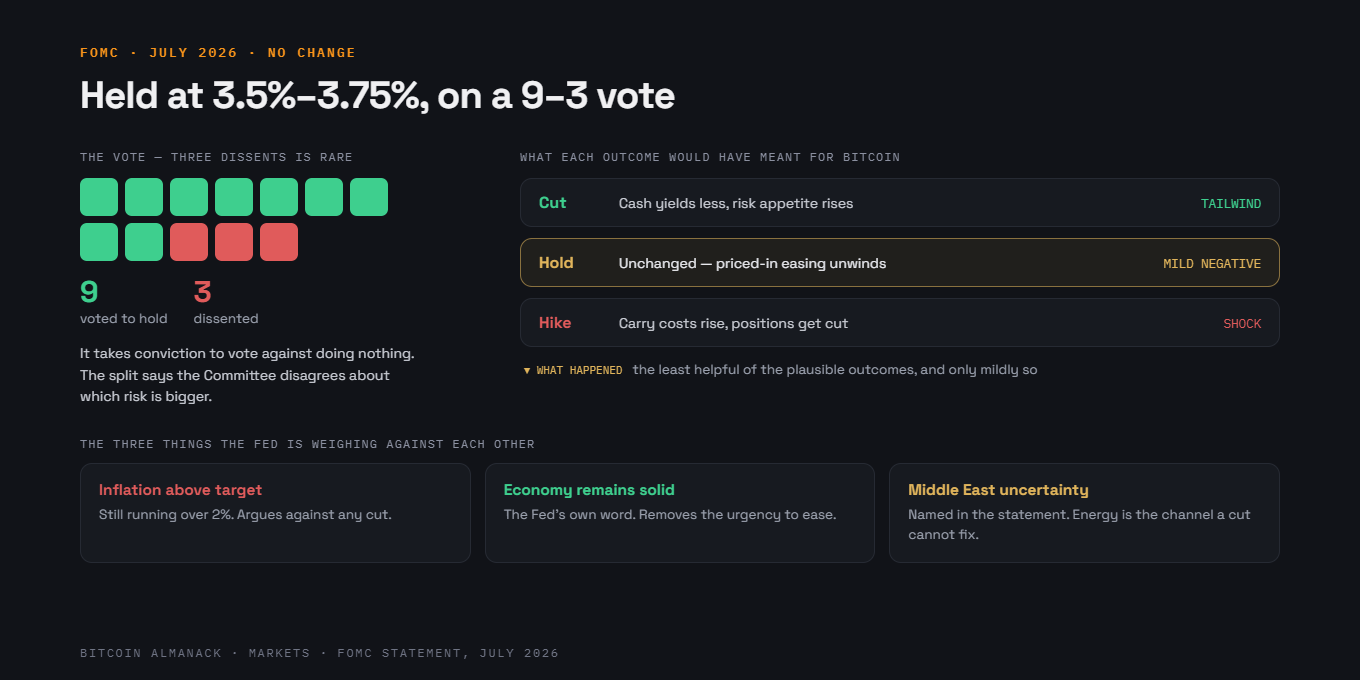
The decision, the split, and the three things the Fed is weighing against each other. Chart: Bitcoin Almanack.
The Federal Open Market Committee left its target range unchanged at 3.5% to 3.75%. The vote was 9 to 3. Inflation is still above the Committee's 2% target, and the statement described the economy as remaining solid despite uncertainty stemming from the Middle East.
Take the three parts in order, because they do not point the same way. A hold is the least dramatic thing a central bank can do and, for anyone holding leverage, the most expensive — the cost of carrying a position does not fall, and any expectation of easing that was baked into pricing has to come back out. Bitcoin's reaction to rate decisions has been consistent for years: it trades as a long-duration risk asset, and higher-for-longer rates keep cash competitive while raising the opportunity cost of holding something that yields nothing.
The 9–3 split is the more interesting number. Three dissents is unusual on any decision and remarkable on a decision to do nothing — it takes conviction to vote against inaction. It says the Committee is genuinely divided about which risk is larger: inflation that has not come home, or growth that may be slowing underneath a solid-looking surface. For markets, a divided Fed makes the next meeting live in both directions, which raises the value of every inflation print between now and then and widens the range of outcomes traders have to hedge.
The Middle East line matters more than it reads. When a central bank names a geopolitical risk in its statement, it is flagging a supply-side channel it cannot control: energy prices feed inflation directly, and an inflation shock driven by oil is the one kind a rate cut cannot fix without making it worse. That is the tension in the statement — solid economy, above-target inflation, external risk the Committee can only watch.
For bitcoin specifically, the honest read is that this was the least helpful of the plausible outcomes, and only mildly so. A cut would have been a liquidity tailwind. A hike would have been a shock. A hold with three dissents removes the easing case without confirming the tightening one, leaving the same interest-rate environment and rather more uncertainty about what follows. That is a mild negative for price and close to irrelevant to the thesis.
It also connects to something we wrote about earlier this week. The three-week run of ETF inflows was broken by two sessions of redemptions that were driven by exactly this repricing — roughly $465 million left the funds on July 23 and 24 as expectations shifted toward a hold. Today's decision confirms what those flows were guessing at. If ETF flows are now the largest single input to weekly price movement, then rate expectations are the largest input to ETF flows, which makes the Fed the biggest indirect force on bitcoin's price that has nothing to do with bitcoin.
None of which should change what a long-term holder does. The supply schedule did not move today. The next halving is still on the same block, and the case for owning a fixed-supply asset is a case about the decade, not the quarter. Rate decisions are how that thesis gets tested emotionally, roughly eight times a year.
BITCOIN ALMANACK ANALYSIS
What each outcome would have meant
OUTCOME
EFFECT ON LIQUIDITY
READ FOR BITCOIN
Cut
Cash yields less, risk appetite rises
Tailwind
Hold — what happened
Unchanged; priced-in easing unwinds
Mild negative
Hike
Carry costs rise, positions get cut
Shock
Three dissents
Next meeting live both ways
More volatility, no direction
Directional readings are ours, not forecasts · Table: Bitcoin Almanack
WHY IT MATTERS
The Fed is currently the largest force acting on bitcoin's price that has nothing to do with bitcoin. Rate expectations drive ETF flows, ETF flows drive a large share of weekly price movement, and none of it touches the supply schedule. Knowing which of your reasons for holding are rate-sensitive and which are not is the whole exercise.
What to watch next
1.Who dissented, and which way. Three votes against a hold could mean three doves wanting a cut, three hawks wanting a hike, or a split between them. The minutes will say, and the answer changes the read entirely.
2.Energy prices. The Middle East line is in the statement because oil is the transmission channel. A sustained crude move would make the inflation problem worse in a way the Committee cannot cut its way out of.
3.Whether ETF flows resume. Two sessions of redemptions preceded this decision on a hold expectation. If flows stay negative now that the hold is confirmed, that is positioning rather than surprise.
4.The next inflation print. With the Committee visibly divided, incoming data has more power over the next decision than usual — and therefore more power over price.
Frequently asked questions
What did the Fed decide?
The FOMC left its target range unchanged at 3.5%–3.75% on a 9–3 vote. The statement said the economy remains solid despite Middle East uncertainty, and inflation is still above the 2% target.
Why does a hold matter for bitcoin?
Bitcoin trades as a long-duration risk asset. Higher-for-longer rates keep cash competitive, tighten the liquidity flowing into risk, and raise the opportunity cost of holding something that pays no yield. A hold is not tightening — but it removes an easing some positions were priced for.
What does a 9–3 vote signal?
Real division. Three votes against the majority say the Committee disagrees about whether above-target inflation or slowing growth is the bigger risk. That makes the next meeting live in both directions and raises the weight of incoming data.
Should this change how I buy bitcoin?
For most people, no. Rate decisions move price on the day and matter enormously to leveraged traders. They have little bearing on a multi-year thesis about fixed supply — dollar-cost averaging exists so this decision does not require an opinion.
SOURCES & DATA
Federal Reserve — FOMC statement, vote and calendar ↗
Federal Reserve — press release for this meeting ↗
FRED — federal funds target range, verify the level yourself ↗
Decision, vote count and statement language as reported at the time of publication; the minutes follow in three weeks and are the authoritative record of who dissented and why. Directional readings are our analysis, not forecasts, and nothing here is investment advice — see our editorial process and corrections policy.

Marisol Vega
Markets & ETFs Reporter. Follows the flow ledger, the funds behind it, and the policy that shapes both.