Why a miner mined an empty block at height 960,017
A block landed on Tuesday morning with nothing in it but the payment to the miner who found it — and zero fee revenue. Nothing broke. The explanation is a gap of one or two seconds, and it is the same gap every time.
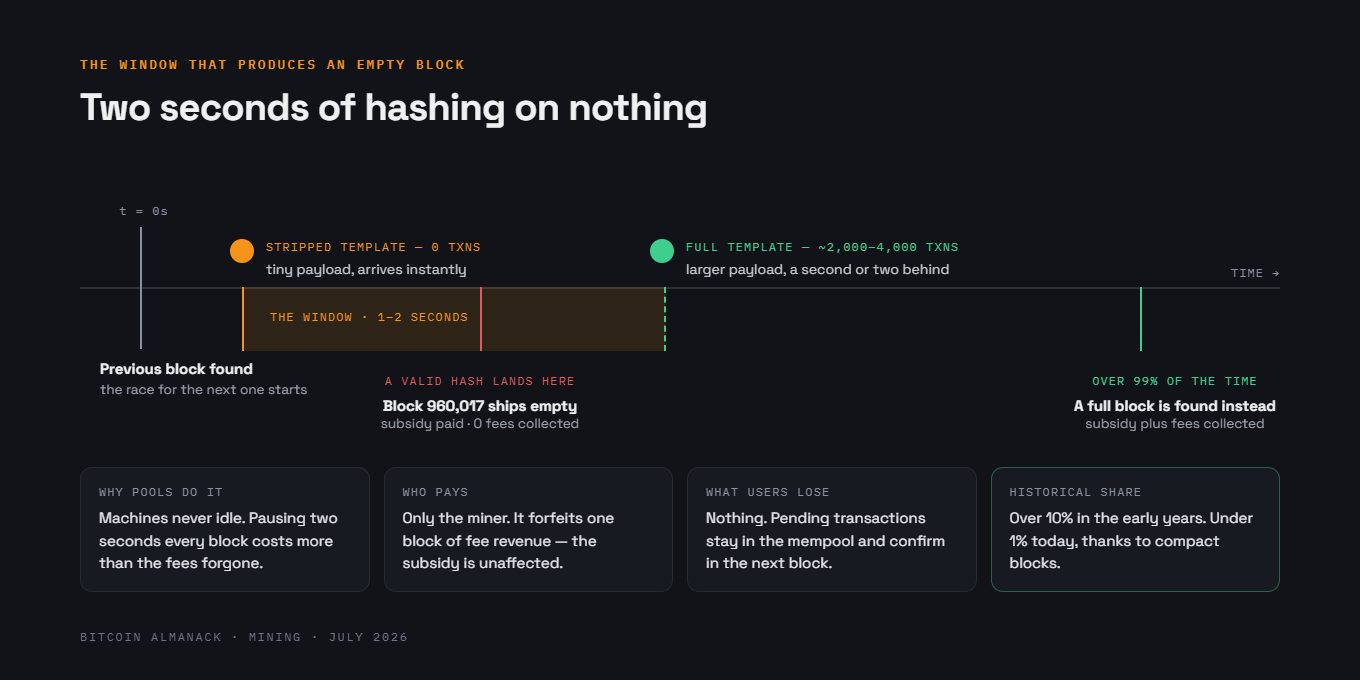
The one-to-two-second window in which an empty block gets found. Diagram: Bitcoin Almanack.
Bitcoin block 960,017 was mined early on Tuesday, July 28, at roughly 02:28 UTC, and it contained exactly zero user transactions. The only thing inside it was the coinbase transaction — the entry that pays the miner its block reward. Fee revenue for the block: nothing.
That sounds like a malfunction and is not one. It is a well-documented behaviour of how pools hand work to machines, and it happens for a reason that takes about two seconds to occur and about two minutes to understand.
When a new block appears on the network, every pool wants its machines hashing on the next one immediately. Building a full template — selecting transactions from the mempool, verifying they are still valid after the block that just landed, assembling the Merkle tree — takes work and produces a larger payload to push out to thousands of machines. So pools send two templates in sequence: first a stripped one with no transactions, which is tiny and arrives instantly, then the full one a moment later.
Machines start hashing the empty template the instant it arrives. Almost always the full template lands before anyone gets lucky, and the block that eventually gets found is a normal full one. Occasionally, inside that one-to-two-second window, a machine finds a valid hash anyway. The block it submits is the one it was holding: empty. That is block 960,017.
The arithmetic behind the choice is not close. The subsidy is currently 3.125 BTC, worth roughly $200,000 at present prices, while a typical block's fees at current mempool levels run in the low hundreds of dollars. A pool that made its machines idle for two seconds after every block, to guarantee it never shipped an empty one, would be trading a small, certain loss of hashing time against a rounding error. No rational operator takes that trade — which is why this behaviour is universal rather than a quirk of one pool.
Attribution for this particular block is unsettled. One report suggests F2Pool, but the block has not been firmly attributed at the time of writing, and we are not treating the label as established. What is verifiable is the pattern: SpiderPool produced the previous notable empty block at height 954,352 on June 19, weighing barely over a kilo weight-unit. Empty blocks exceeded ten percent of all blocks in Bitcoin's early years; today they run under one percent, largely because of faster propagation techniques such as compact blocks and better pool software.
Nothing was lost by anyone else. No transaction was dropped, reversed, or delayed beyond the next block a few minutes later — the mempool simply held its queue. The difficulty adjustment does not care whether a block was full, so issuance continued exactly on schedule. There was no market reaction, and there should not have been one: the only party out of pocket is the miner that forfeited a block's worth of fees for the privilege of never letting its machines rest.
BITCOIN ALMANACK ANALYSIS
Block 960,017 against a normal block
BLOCK 960,017
TYPICAL BLOCK
User transactions
0
~2,000–4,000
Fee revenue
0 BTC
Low hundreds of $
Block subsidy
3.125 BTC
3.125 BTC
Valid under consensus
Yes
Yes
Anything lost by users
Nothing
Nothing
Share of all blocks
Under 1% today
Over 99%
Transaction counts and fee levels are typical ranges at current mempool conditions · Table: Bitcoin Almanack
WHY IT MATTERS
Empty blocks are a useful stress test of your own mental model. If one makes you nervous, the thing to examine is the assumption that every block must be full for the system to be working. Bitcoin's guarantee is that valid blocks extend the chain on schedule — not that any particular block carries your payment. The queue is the mempool's job; the clock is the network's.
What to watch next
1.Whether the rate stays under 1%. A sustained rise would point at propagation problems or pool software regressions, not at anything wrong with consensus. That is the metric worth tracking, not any single block.
2.Fee pressure changes the maths. Empty blocks are cheap to ship while fees are a rounding error next to the subsidy. In a high-fee regime — or after the next halving cuts the subsidy again — forfeiting a full template gets expensive, and pools tighten the window.
3.Attribution. The coinbase tag is the usual way pools identify themselves. If this block goes unattributed, that is mildly interesting for hashrate-share accounting and nothing more.
Frequently asked questions
What is an empty block in Bitcoin?
A valid block containing only the coinbase transaction that pays the miner, and no user transactions. Technically it is an ordinary block — see our empty block explainer for the full mechanics.
Why would a miner do this on purpose?
Usually it is not on purpose. Pools push a stripped template the instant a block is found so machines never idle, then follow with the full one. A hash found inside that gap ships an empty block. Waiting would cost more hashing time than the fees are worth.
Did anyone's transaction get lost?
No. Nothing was dropped or reversed. Pending transactions stayed in the mempool and confirmed in the next block a few minutes later. The only loss was the miner's forfeited fee revenue.
How common are empty blocks now?
They exceeded 10% of blocks in Bitcoin's early years and run under 1% today, thanks to compact blocks and better pool software. SpiderPool mined the previous notable one at height 954,352 on June 19, 2026.
SOURCES & DATA
Crypto Briefing — report on block 960,017, timestamp and zero-fee detail ↗
mempool.space — block 960,017, verify transaction count and coinbase yourself ↗
BitcoinWiki — empty block reference ↗
The mining entity behind this block is single-sourced and unconfirmed; we describe it as unattributed rather than naming a pool. Subsidy value converted at the prevailing spot price. See our editorial process and corrections policy.

Aisha Bennett
Mining & Hardware Reporter. Tests ASICs, tracks hashprice, and reads power contracts so you do not have to.
MORE FROM THIS WEEK
Three green weeks, seven percent recovered: where ETF flows actually stand
MARKETS
The Bitcoin Miner's Almanac review: the mining book that treats hashrate as a business
BOOK REVIEW
Hashrate keeps climbing while margins do not: the squeeze in one chart
MINING
Bitcoin is about to turn one million blocks old. Here's what that actually means
NETWORK