The Bitcoin Miner's Almanac review: the mining book that treats hashrate as a business
Rob Warren spent his working life inside mining operations before he wrote about them, and it shows. This is the first general-audience mining book whose centre of gravity is power contracts and unit economics rather than hardware spec sheets.
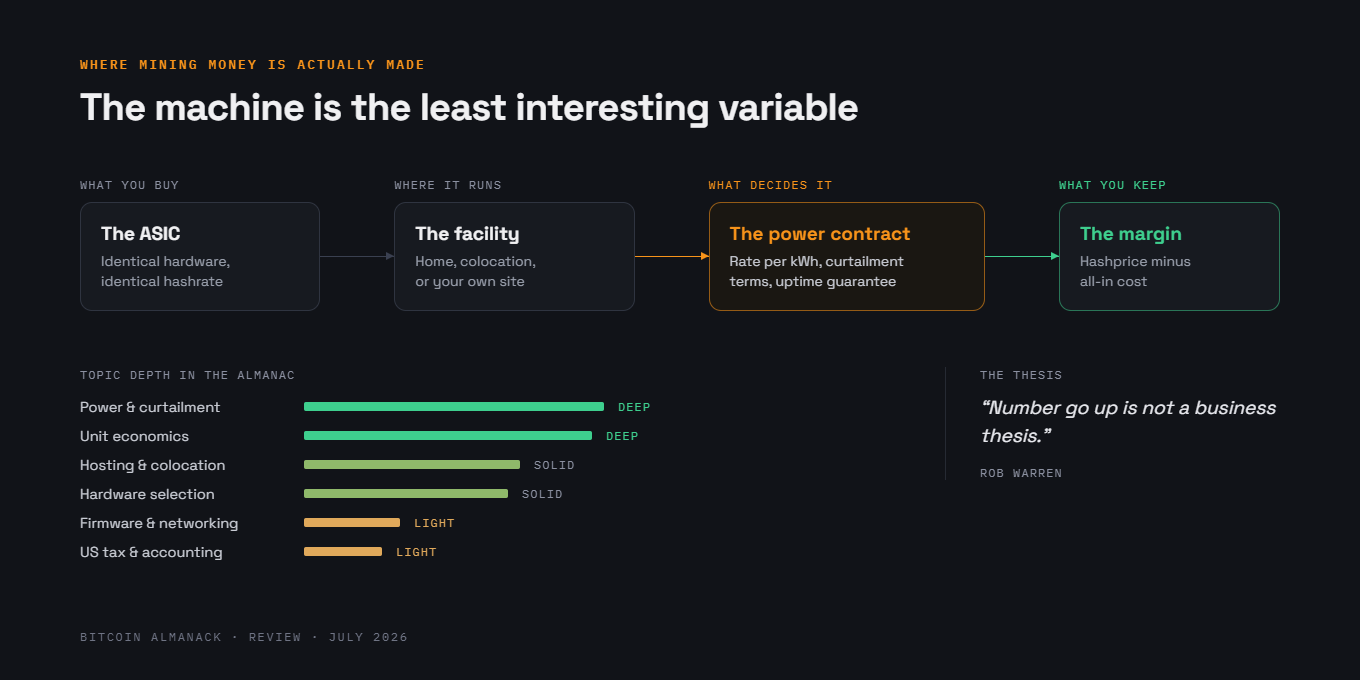
Where mining margin is actually decided, and how deeply the Almanac covers each link. Diagram: Bitcoin Almanack.
OUR SCORE
8.4/10
Best single starting point for the business of mining. Read it before you buy a machine, not after.
THE BOOK
Robert Warren · 2024, second edition planned
Print & digital · Amazon and the Bitcoin Magazine store
ISBN 9798989132638
Most bitcoin mining writing fails in one of two directions. It is either an engineering document that assumes you already own a facility, or it is an explainer that stops at "computers solve puzzles." The Bitcoin Miner's Almanac lands in the gap between them, and the reason is biographical: Warren wrote it while working on mining projects and operations analysis at Riot Platforms, and the book carries the texture of someone who has had to defend a power bill.
The subtitle — Where Code Meets Business and Everything in Between — is an accurate table of contents. The book moves from what a machine actually is, through the facility that houses it, to the contracts that determine whether the whole exercise makes money. That ordering is the argument: the machine is the least interesting variable. Two operators running identical ASICs can post opposite results because one signed a curtailment-friendly power agreement and the other did not.
Warren's strongest chapters are the ones a hobbyist would skip. Power procurement, demand response, hosting agreements, and the arithmetic of hashprice get patient treatment, with case studies rather than hypotheticals. He is unsentimental about the last cycle in a way that reads as earned: his shorthand from a 2024 essay — that number-go-up is not a business thesis — is essentially the book's thesis in one line. Miners who bought S19s above ten thousand dollars on double-digit debt learned that lesson at market rates.
The framing device that will stay with most readers is the miner-as-appliance idea: a machine is a box that converts electricity into heat, with a small residual of hashrate as the by-product you happen to be paid for. Once mining is a heat business, decisions that look eccentric from outside — home units in a garage, colocation in someone else's shed, containers in a gas field — become variations on where you can source cheap power and dump waste heat.
It is not a manual, and does not claim to be. If you want to underclock a machine, configure a pool, or plumb an immersion tank, you will be back on vendor documentation and forum threads within an hour. Tax and accounting treatment gets less space than a US operator will eventually need — our bitcoin tax guide is a better starting point there. And print cannot track hardware: efficiency figures and machine prices in any mining book are illustrative by the time they ship, which is why the book pairs best with live data from our miner rankings and hashprice tracking.
The other thing worth naming is who it is not for. Someone still deciding whether bitcoin matters will find the book assumes that question settled. It is a trade book about an industry, written for people considering whether to join it. That focus is exactly why it works — and the reason the second edition is worth waiting for if you are not buying machines this quarter.
BITCOIN ALMANACK ANALYSIS
Coverage by topic — and where you still need something else
TOPIC
DEPTH
PAIR IT WITH
Power contracts & curtailment
Deep
Your utility tariff sheet
Unit economics, hashprice
Deep
Live hashprice data
Hosting & colocation risk
Solid
The actual contract
Hardware selection
Solid
Current spec sheets
Firmware tuning, networking
Light
Vendor docs, forums
US tax & accounting
Light
A crypto-literate CPA
Heat reuse projects
Light
Vendor case studies
Editorial assessment of topic depth, not a page count · Table: Bitcoin Almanack
WHY IT MATTERS
Mining is the part of bitcoin most often bought emotionally and least often modelled. A generation of home and mid-size miners lost money in the last cycle not because they picked the wrong machine but because they never wrote down the business. A book that makes power contracts and unit economics the main character is doing more for miner survival rates than any hardware review — including ours.
Read it if, skip it if
READYou are within a year of spending real money on hashrate — one machine or one megawatt. The chapters on power and hosting will pay for the book many times over.
READYou analyse listed miners and want the operating vocabulary behind the earnings calls.
SKIPYou need a build guide tonight. This is the strategy layer, not the wiring diagram.
WAITYou are not deploying capital this year and would rather read the announced second edition with refreshed hardware and market figures.
Frequently asked questions
Who is The Bitcoin Miner's Almanac for?
Anyone deciding whether to put capital into hashrate: home miners sizing a first machine, operators moving from a few units to a few megawatts, and analysts covering listed miners. It assumes you already understand what bitcoin is, and spends its pages on how a mining operation makes or loses money.
Does the book teach you how to set up a miner?
Partly. It explains the hardware, the facility, and the trade-offs in plain language, but it is not a step-by-step firmware and networking manual. For underclocking, pool configuration, and immersion plumbing you will still need vendor documentation and community guides.
Is a book about mining out of date by the time it prints?
Model numbers age; the framework does not. Efficiency figures and machine prices in any printed mining book should be treated as illustrative — check current hashprice and specs live. The reasoning about power contracts, hosting risk, and unit economics stays valid across hardware generations.
Where can you buy it?
Through Amazon and the Bitcoin Magazine store, in print and digital editions, with the digital edition available immediately after purchase. Warren has said a second edition is planned.
SOURCES & DATA
Bitcoin Magazine store — publisher listing, editions and endorsements ↗
The Mining Pod — "The Bitcoin Miner's Almanac With Rob Warren" interview ↗
Braiins — Warren on the four lessons of the last mining cycle ↗
Amazon — edition details and ISBN ↗
Reviewed from a purchased copy. No compensation was received from the author or publisher, and the links above are not affiliate links. See our editorial process and affiliate disclosure.

Aisha Bennett
Mining & Hardware Reporter. Tests ASICs, tracks hashprice, and reads power contracts so you do not have to.
MORE FROM THIS WEEK
Why a miner mined an empty block at height 960,017
MINING
Bitcoin Almanac on TradingView: a cycle model that never repaints, because it never looks
TOOL REVIEW
Hashrate keeps climbing while margins do not: the squeeze in one chart
MINING
Antminer S21 XP review: the efficiency benchmark, at a price
HARDWARE