4.3/5
PROVISIONAL SCORE
4.4 TH/s
VENDOR STOCK RATE
42 W
VENDOR STOCK DRAW
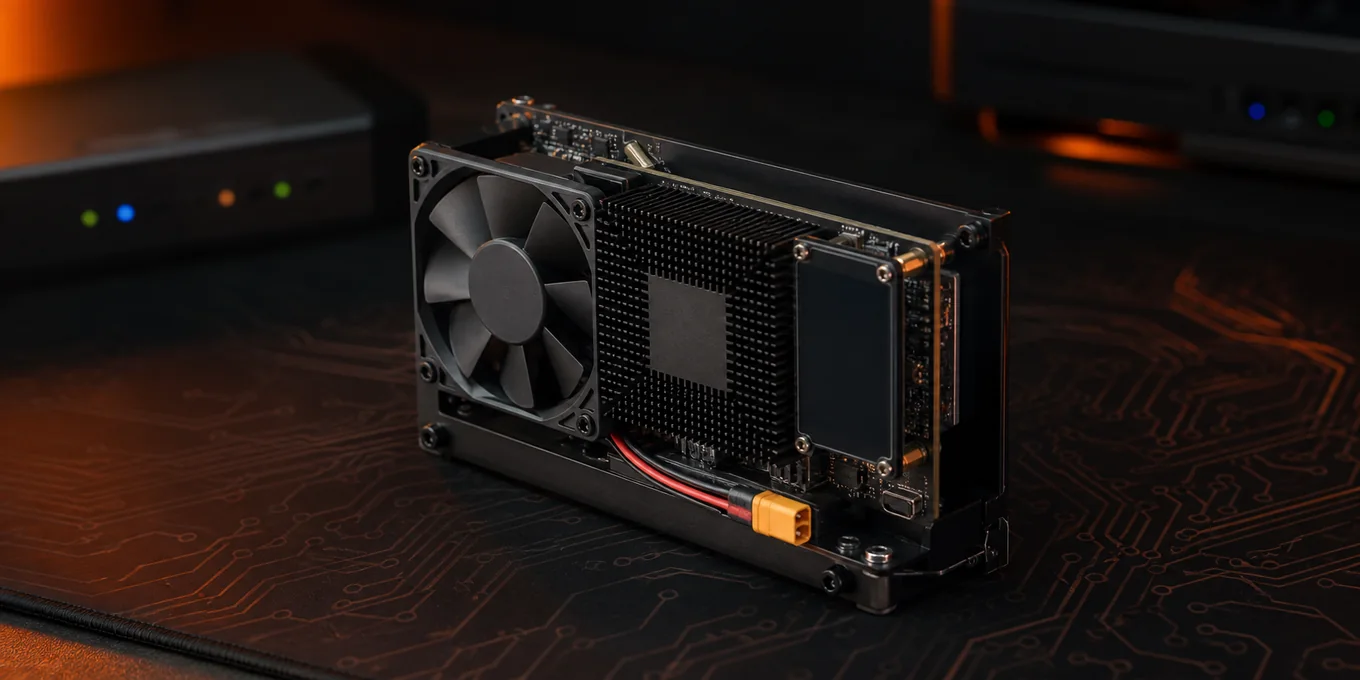
The Bitaxe Naja Duo is the first Bitaxe built around two of Bitmain’s BM1373 chips, the 3nm silicon associated with the S23 generation. Solo Satoshi rates the Model 1201 at approximately 4.4 TH/s while drawing 42 watts—about 9.5 joules per terahash at factory settings.
That combination is the headline. Earlier desk miners made open-source home mining approachable but asked buyers to accept a large efficiency penalty. If the production unit sustains the published figures, the Naja Duo moves the category closer to modern industrial efficiency while remaining small, inspectable and Wi-Fi connected.
Our provisional score
Architecture and openness: 4.8/5. Open hardware, esp-miner firmware and the AxeOS dashboard are the right foundation. USB-C flashing and visible controls reduce dependence on a vendor cloud.
Efficiency: 4.7/5. The claimed 9.5 J/TH at stock is exceptional for the Bitaxe class. This score must remain provisional until retail measurements confirm wall draw rather than board-level estimates.
Usability: 4.2/5. A 1.9-inch color LCD, 2.4 GHz Wi-Fi and AxeOS should make setup familiar to existing Bitaxe owners. The XT30 connector is more appropriate than a marginal barrel connector at higher power, but buyers must select the correct supply.
Value: 3.6/5. At $389.99 without the optional supply—or $409.99 with the listed configuration—the Naja Duo costs far more per terahash than used industrial hardware. The premium buys size, efficiency, openness and livability, not superior mining revenue.
Support and warranty: 3.8/5. U.S. assembly, testing and domestic fulfillment are positives. A 90-day limited warranty is short for a device expected to run continuously.
Specifications that matter
| ASICs | 2× Bitmain BM1373, 3nm |
|---|---|
| Stock performance | ~4.4 TH/s, ~42 W, ~9.5 J/TH |
| Vendor-tested overclock | ~8 TH/s, ~92 W, ~11.5 J/TH |
| Cooling | Thermalright AXP90-X47 heatsink; TL-9015B 92mm PWM fan |
| Power | 12V DC through XT30 |
| Interface | AxeOS, 1.9-inch LCD, 2.4 GHz Wi-Fi, USB-C |
| Warranty | 90 days limited |
The overclock is impressive—and not the default recommendation
Solo Satoshi reports testing approximately 8 TH/s at 600 MHz and 1,120 mV, with power rising to about 92 watts. That is an 82% hashrate increase for a 119% power increase, so efficiency falls to roughly 11.5 J/TH.
The optional 12.4V, 10A supply provides adequate published headroom, but overclocking adds heat, acoustics and component stress. The vendor warns that results vary by silicon and that damage caused by voltage, frequency or temperature may not be covered. We would run stock settings first, record stable temperatures, and increase one tier at a time only after understanding the risk.
Electricity is affordable; expected solo revenue is not
At 42 watts, continuous operation consumes about 30.7 kWh per month. That costs approximately $3.68 at $0.12 per kWh, before taxes or utility fees. At the reported 92-watt overclock, monthly consumption rises to about 67.2 kWh, or $8.06 at the same rate.
Those manageable bills do not make solo mining predictable. Your chance of finding a block is your hashrate divided by the entire Bitcoin network’s hashrate. At 4.4 TH/s against a network measured in hundreds of exahashes per second, the expected wait is measured in millennia. A block can arrive tomorrow; probability does not promise that it will arrive within your lifetime.
A payout pool can turn the same hashrate into tiny regular credits, but transaction thresholds and fees matter. Buy this machine to learn, participate, heat a small space or enjoy a verifiable lottery—not because a revenue calculator shows a dependable payback period.
Who should buy it?
Best for: Bitcoiners who want the strongest published Bitaxe efficiency, value open hardware, already understand solo-mining odds and prefer a quiet desk-scale device over used industrial equipment.
Skip it if: your primary goal is return on investment, you need a long warranty, your network cannot use 2.4 GHz Wi-Fi, or you are uncomfortable selecting and monitoring a 12V power supply.
VERDICT · 4.3/5 PROVISIONAL
The Naja Duo’s published 4.4 TH/s at 42 watts is a meaningful generational step for open-source home mining. The architecture earns a recommendation for enthusiasts, but the score remains provisional until independent retail testing confirms hashrate, wall power, temperatures and acoustics.
AFFILIATE DISCLOSURE
Bitcoin Almanack may earn a commission if you purchase through the Solo Satoshi link, at no additional cost to you. The relationship does not change our score or the limitations described above. Read our affiliate policy.