
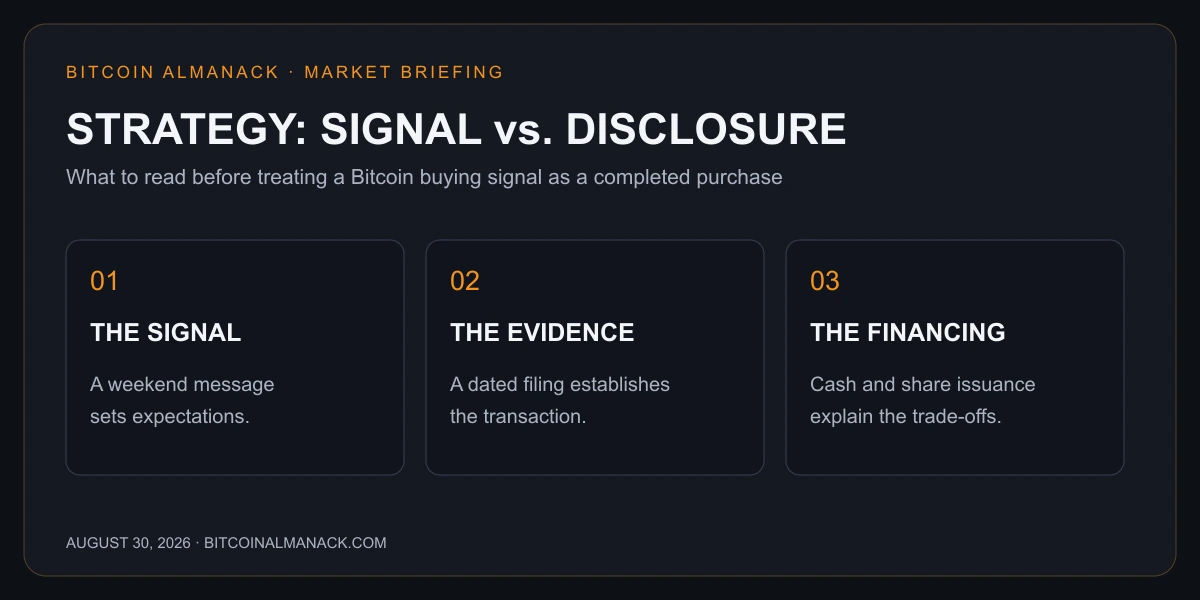
Michael Saylor’s weekend message puts a familiar question back in front of Bitcoin investors: is Strategy about to buy again? His August 30 “We’re ₿ack” post, accompanied by a Bitcoin purchase-history chart, points toward that possibility. It does not supply the transaction details needed to establish a new purchase.
The distinction matters tonight. A message can change expectations before any fresh demand is documented. Monday’s useful evidence would be a company release or filing showing what Strategy bought, when it bought it and how it funded the transaction. Until then, this is a purchase signal—not a purchase announcement.
Subsequent coverage: Strategy has since disclosed its purchase. Read the August 31 confirmation and the reported figures. This earlier article preserves the information available when the buying signal appeared.
What Strategy has actually disclosed
Strategy’s August 24 disclosure reported 840,447 BTC held as of August 23, with no purchases or sales during that reporting week. The company reported an aggregate acquisition cost of $63.36 billion and an average cost of $75,385 per bitcoin, including fees and expenses.
It also separated two dollar pools: a $5.10 billion USD Reserve and $1.59 billion of USD Cash. The reserve supports preferred dividends and debt interest. The more flexible cash pool can fund Bitcoin acquisitions, but also securities repurchases, debt repayment and other treasury purposes. Those balances included expected proceeds from share sales that had not yet settled.
That makes “cash available” different from “cash committed to Bitcoin.” The new arrangement creates options for management; it does not earmark the entire balance for an imminent market purchase.
Why a new Strategy Bitcoin purchase would matter
For a Bitcoin treasury company, an acquisition is both an asset-allocation decision and a financing decision. The headline number of coins answers only the first question. Investors also need to understand what changed on the other side of the balance sheet.
A purchase funded from existing cash reduces liquidity. One financed through new shares increases the share count. Preferred securities introduce their own claims on future cash. Our guide to at-the-market offerings explains the share-sale mechanism often discussed alongside Strategy’s Bitcoin holdings.
A resumed buying program could add a visible corporate buyer to the market. It would not, by itself, prove that broader demand has recovered. One company’s allocation and the combined activity of spot ETF investors are separate signals, particularly after Friday’s Bitcoin ETF outflows.
Three details to read before reacting on Monday
First, the reporting period. A Monday announcement can describe purchases completed during the previous week. It should not be presented as evidence that the same amount of buying is happening at the moment the headline appears.
Second, the financing. Compare the acquisition with changes in cash, share issuance and outstanding obligations. A large Bitcoin total can coexist with material dilution or a smaller liquidity cushion.
Third, the scale. Judge any announced purchase against Strategy’s existing holdings and the surrounding market. The significance of restarting and the significance of the amount are not necessarily the same.
The broader Bitcoin test this week
The Bitcoin week-ahead calendar includes U.S. labor data and the jobs report, alongside the next completed ETF-flow sessions. Those developments may reinforce a corporate-demand story—or overwhelm it. The Bitcoin tracker provides current market context without turning an old article’s price quote into a supposedly live number.
The takeaway is straightforward: Saylor has given the market a reason to watch Strategy. A filing is what turns that expectation into a measurable transaction. If an acquisition is disclosed, its size, timing and funding will tell readers more than the teaser.
SOURCES & DATA · AUGUST 30, 2026
Michael Saylor’s August 30 post; Strategy’s August 24 release and linked Form 8-K. Holdings and cash figures are dated August 23, not live balances. The post is a signal; no new purchase amount is established here. Market analysis is not investment advice.

Marisol Vega
Bitcoin Almanack's editorial byline for Bitcoin markets, spot ETF flows, institutional activity, regulation, and daily news.