What Happens If Your Bitcoin Hardware Wallet Company Shuts Down?
If Ledger, Trezor or another hardware wallet maker disappeared tomorrow, your bitcoin would not disappear with it. The important question is whether you preserved what is needed to reconstruct control of your keys.
BY SAM OKAFOR7 MIN READ
Updated
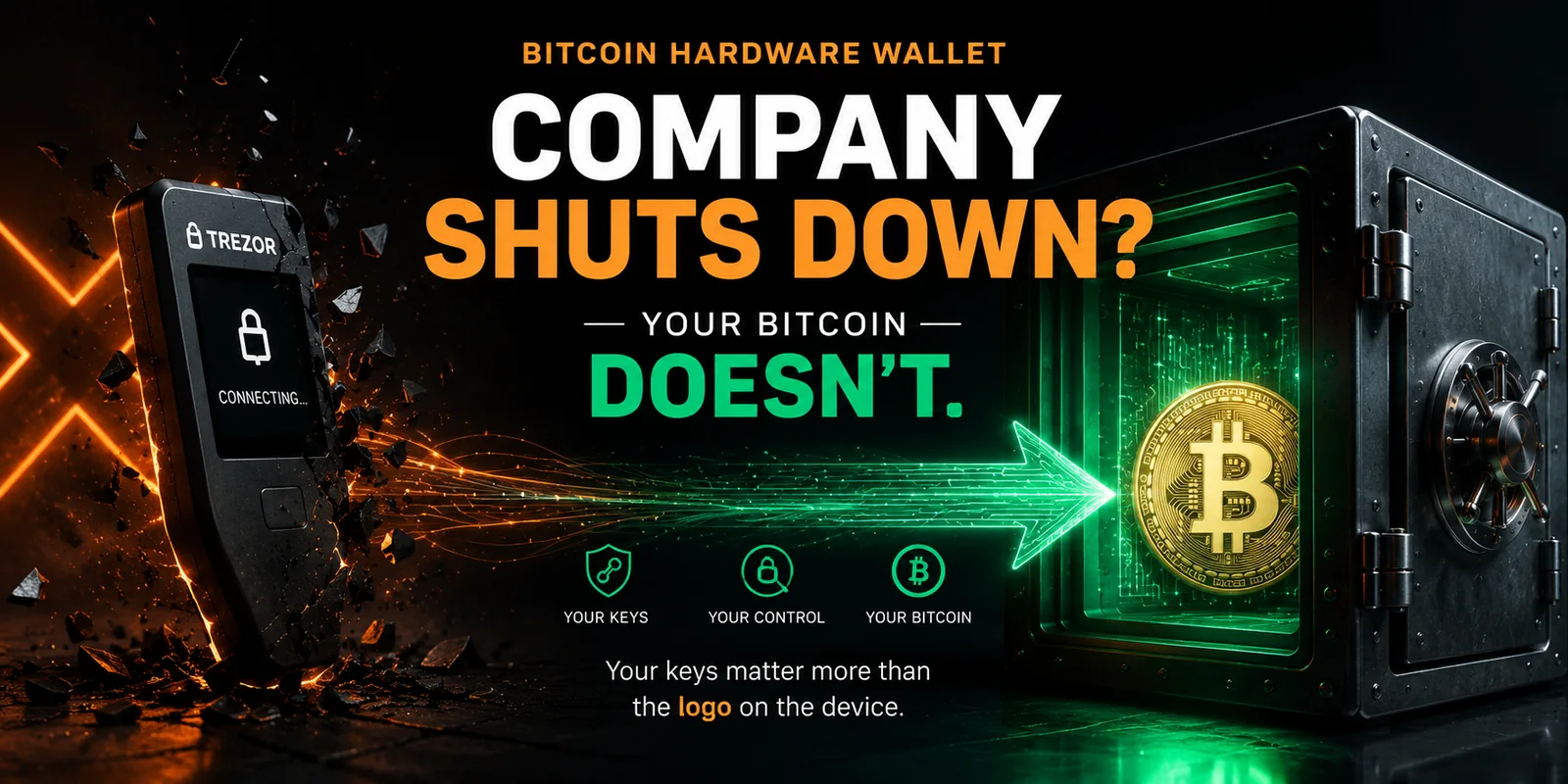
Your hardware wallet can break. Its app can disappear. The company that made it can even go out of business. None of those events, by themselves, erase your bitcoin.
Your bitcoin is not stored inside the hardware wallet. Bitcoin remains recorded on the blockchain. The device protects the private keys used to authorize transactions. That distinction is the reason a well-backed-up self-custody wallet can survive the failure of the company that manufactured the device.
If the company disappears, what actually happens?
Imagine the manufacturer shuts down, its website goes offline and its wallet app eventually stops receiving updates. The immediate problem is the software and hardware you use to interact with your keys — not the existence of your bitcoin.
If your wallet uses a portable backup standard and you still have the correct backup information, you can generally restore the wallet on compatible hardware or software. Trezor, for example, says its BIP39 backups are widely supported and can restore a wallet without a Trezor device. Its current Safe 7 recovery documentation also supports importing valid BIP39 or SLIP39 backups created by another hardware wallet.
That is the core idea behind self-custody: control ultimately follows the keys, not the continued existence of a particular company.
The backup matters more than the device
For many hardware wallets, the critical recovery material is a seed phrase, also called a recovery phrase or wallet backup. A common standard is BIP39, which represents the entropy used to derive wallet keys as an ordered list of words.
Trezor describes a wallet backup as the information necessary to recover access to funds on-chain and warns that anyone with that backup can control the associated wallet. The BIP39 specification also allows an optional passphrase to participate in deriving the seed, which is why a seed phrase alone may not reproduce a passphrase-protected wallet.
The simple version: the hardware is replaceable. A missing or incorrect backup may not be.
Can you restore the wallet on another brand?
Often, yes — but compatibility should never be assumed blindly. A standard backup makes portability possible, not automatic in every configuration.
Recovery can depend on the backup format, derivation path, Bitcoin address type, passphrase use and whether the wallet is part of a multisig setup. Some wallet-specific features may also require additional information beyond a list of recovery words.
That is why the right question is not simply, “Do I have my seed?” It is, “Do I have everything required to reconstruct this exact wallet?”
What if Ledger shut down?
This is a hypothetical example, not a claim that Ledger is shutting down. If a Ledger owner had a standard recovery phrase and the information required for the wallet configuration, the company's disappearance would not move or delete the bitcoin recorded on-chain.
The owner would need a compatible recovery path. The same principle applies to any hardware wallet: the manufacturer's device is a tool for protecting and using the keys; it is not the location where the bitcoin itself lives.
If you are choosing between major devices now, our Trezor vs. Ledger comparison looks at the products themselves. This article addresses the different question of what happens when the manufacturer is no longer available.
What if Trezor shut down?
Again, this is hypothetical. Trezor's current documentation explicitly emphasizes portability: BIP39 backups are widely supported by other wallets, and valid backups can be imported to compatible devices.
Trezor also warns about the opposite case. If the device is inaccessible and the required wallet backup is lost, Trezor cannot recover the wallet for you. That is the tradeoff of self-custody: eliminating dependence on a custodian also eliminates the custodian's ability to reset access for you.
A passphrase changes the recovery equation
BIP39 supports an optional passphrase. If you used one, the same recovery words with a different passphrase derive a different wallet. Recovering the words but forgetting the passphrase can therefore lead to a perfectly valid wallet that does not contain the bitcoin you expected to see.
That makes documentation important. A recovery plan needs to preserve the requirements of the actual wallet configuration without exposing those secrets to someone who should not have access.
Multisig needs more than a casual backup plan
A multisig wallet deliberately spreads signing authority across multiple keys. That can reduce dependence on a single device, but it also means recovery has more moving parts.
Before relying on multisig, use our multisig setup checklist and understand what keys, wallet configuration and recovery information your particular setup requires. Do not assume one seed phrase is enough to reconstruct an entire multisig wallet.
What should you preserve?
For a straightforward wallet, start with the correct offline wallet backup and an understanding of whether a passphrase is part of the setup. For more advanced configurations, preserve the additional recovery information required by that wallet.
Do not photograph a seed phrase, email it to yourself or store it in an ordinary cloud note. Trezor's current guidance says to keep wallet backups offline and private and specifically warns against screenshots, photographs, email and cloud storage.
And if a hardware-wallet company really did collapse, expect scammers to exploit the confusion. Never type recovery words into a random “migration” or “recovery” website. A seed phrase gives control of the wallet to whoever possesses it.
Should recovery portability affect which wallet you buy?
Yes. Recovery is part of the product, even though you hope never to use it.
Before choosing a device, ask what backup standard it uses, whether that backup can be recovered elsewhere, whether your setup uses a passphrase, and whether any important feature depends on proprietary software. Then compare those considerations with security model, usability and price in our Bitcoin wallet rankings and wallet comparisons.
The bottom line
A hardware-wallet manufacturer going out of business would be inconvenient. It could mean changing software, buying a different device and learning a new recovery process. It should not, however, make properly backed-up bitcoin vanish.
The device is replaceable. The company is replaceable. Your ability to reconstruct control of the keys is what matters.
That is the power — and the responsibility — of self-custody.

Sam Okafor
Bitcoin Almanack's editorial byline for hardware wallets, software wallets, seed backups, multisig, recovery, and self-custody security.
For a product-level comparison alongside these recovery considerations, see our Ledger hardware wallet guide and Trezor Safe 5 review.