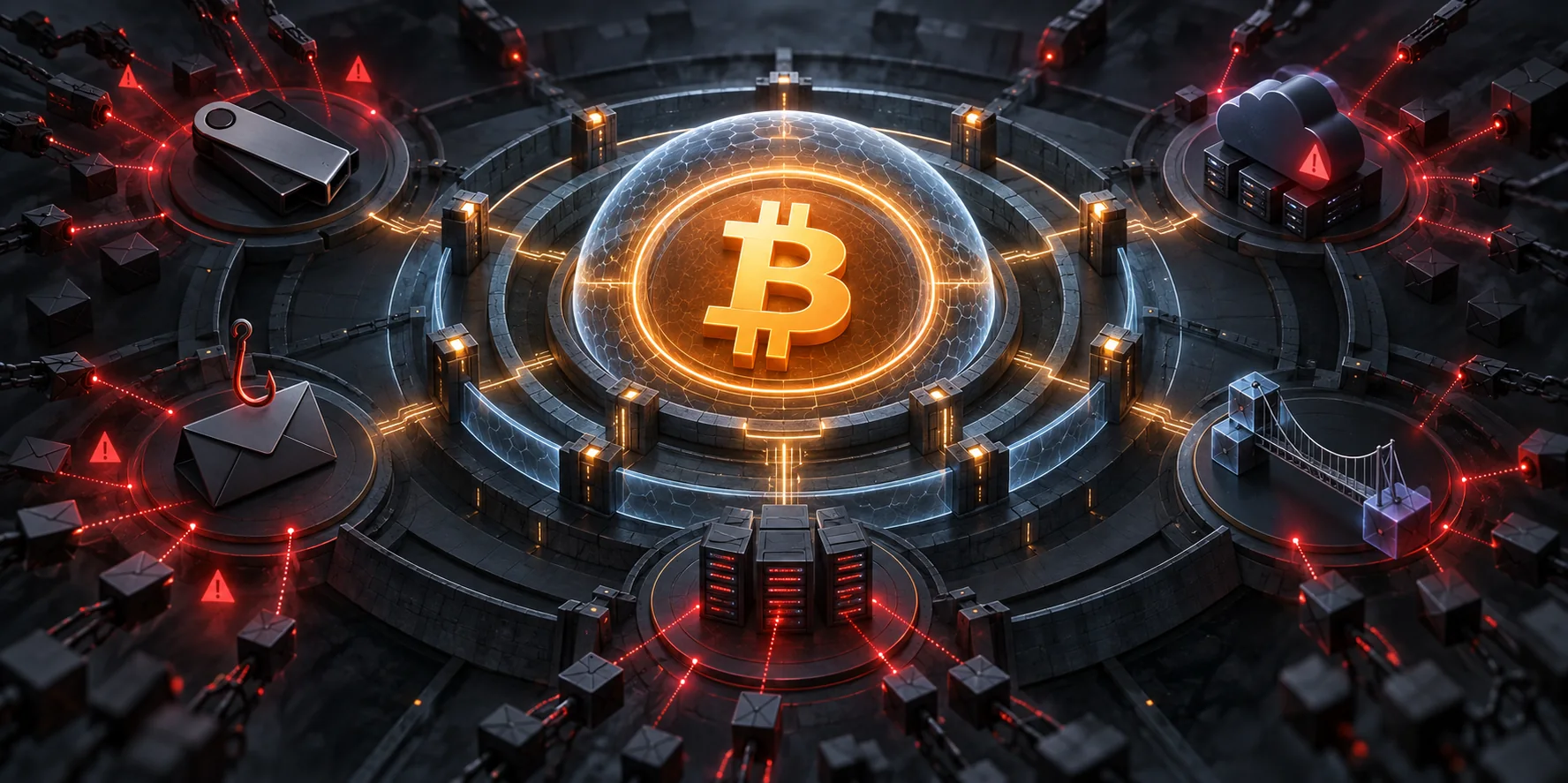
Bitcoin security attacks appear to be clustering in 2026. Trezor users have faced convincing phishing. A COLDCARD firmware defect weakened some wallet seeds. A Liquid security incident led to the withdrawal of roughly 4,000 BTC from a federation wallet.
Those headlines can sound like one story: “Bitcoin keeps getting hacked.” They are not.
Each incident reached a different layer of the system around Bitcoin. Understanding that layer determines who is at risk, what must be repaired and whether the Bitcoin network itself failed.
Bitcoin security attacks are not one category
Bitcoin is a protocol run by independent nodes. It defines valid transactions, blocks, issuance and consensus. Users reach it through a much larger security stack:
- Wallet hardware and firmware generate or protect keys.
- Seed-generation processes create the secret material behind a wallet.
- Exchanges and custodians hold keys on behalf of customers.
- Sidechains and federations add separate rules, bridges and authorization systems.
- Email, shipping and SaaS vendors store identity or communication data.
- Users verify addresses, updates, backups and support messages.
A failure in any outer layer can lose bitcoin without changing Bitcoin's consensus rules. “Bitcoin hack” is therefore usually an inadequate diagnosis.
Trezor phishing targeted the human layer
The September 9 Trezor phishing email claimed a critical entropy problem and sent users toward a browser checker. Its objective was to turn technical fear into disclosure of a wallet backup.
Trezor's official guidance says the company will never ask for recovery words and warns that professional-looking messages cannot be trusted on appearance alone. Separately, Trezor's ShipMonk disclosure says customer identity and shipping data were exposed and could raise phishing risk, while its devices remained secure.
This was not a Bitcoin consensus failure or verified cryptographic break of a Trezor Safe 5. It was an attack on email infrastructure, trust and recovery-seed custody.
COLDCARD exposed a seed-generation failure
The COLDCARD incident reached a deeper technical layer. Coinkite's technical backgrounder says a build-and-link integration error caused affected firmware to use a general-purpose pseudorandom number generator in a seed-generation path that was intended to rely on hardware randomness.
Attackers could regenerate corresponding private keys offline and steal funds from weak seeds. Coinkite says the devices were not remotely accessed or taken over. The failure occurred when the wallet created key material.
That distinction does not reduce the harm. It changes the remedy. Installing fixed firmware prevents the same generation path from being used again, but it does not strengthen a seed that was already created. Coinkite instructs affected users to update, generate a completely new seed and migrate funds.
Bitcoin Almanack covered the initial disclosures in its COLDCARD security report. Users moving funds should verify the current model-and-release guidance at Coinkite rather than relying on a headline or firmware number copied out of context.
Liquid exposed federation and bridge risk
Blockstream's status page reports that purported white-hat hackers withdrew roughly 4,000 BTC—about $320 million—from the Liquid Federation wallet via the SideSwap peg-out authorization key. Blockstream said that key itself, and the other keys, were not compromised. Public bridge nodes were temporarily disabled while federation members responded.
Liquid is a Bitcoin sidechain with its own federation, bridge and authorization model. Its users can move value represented by L-BTC, but its security assumptions are not identical to Bitcoin's decentralized base-layer consensus.
The Liquid incident was not a hack of Bitcoin's blockchain. It was a serious failure in infrastructure connected to Bitcoin. Bitcoin continued producing blocks and validating base-layer transactions while Liquid activity was disrupted.
The difference is operationally important. A Bitcoin node operator did not need a consensus patch because a Liquid federation wallet was drained. Liquid federation members and users did need incident-specific guidance.
Why attacks around Bitcoin may be increasing
No single public dataset proves that every form of Bitcoin-related attack has risen by a specific percentage in 2026. What the recent cluster does show is why the economic incentive and attack surface are expanding.
More value is at stake. Large balances make a single seed, signing process or bridge authorization worth sustained research and social engineering.
More users create more targets. New self-custody users may understand Bitcoin's investment case before they understand recovery procedures.
More infrastructure creates more boundaries. Wallet firmware, exchanges, hosted services, bridges, customer databases and communication tools each add software, permissions and people outside Bitcoin Core.
Settlement is difficult to reverse. Once an attacker controls valid keys and broadcasts a valid transaction, there may be no administrator capable of undoing it.
Operational complexity compounds. A secure base protocol does not automatically make every build pipeline, vendor account, backup plan or federation secure.
What has actually not been broken?
None of these incidents demonstrates that an attacker changed Bitcoin's 21-million supply rule, forged a valid signature without a key, rewrote the network's consensus rules or took control of the blockchain.
That is the defensible boundary. It would be too broad to say that nothing connected to Bitcoin has ever failed; exchanges, wallets, bridges and users have suffered catastrophic losses. It is also misleading to transfer those failures to Bitcoin's consensus layer.
Bitcoin security is strongest when claims identify the layer precisely. A phishing email needs user education and account-security controls. A weak seed needs migration. A compromised custodian needs containment and reserves. A federated sidechain incident needs a federation response. A true consensus flaw would require an entirely different network-level reaction.
What Bitcoin users should learn from 2026
- Keep recovery words offline. No legitimate checker, wallet maker or support agent needs them.
- Verify software through official channels. Treat email links and urgent update notices as untrusted.
- Replace weak or exposed seeds. A firmware update cannot retroactively repair key material.
- Use a strong, unique passphrase when appropriate. Understand its recovery risk before adding one.
- Minimize vendor exposure. Use privacy-conscious purchase and communication practices where practical.
- Understand the custody model. A hardware wallet, exchange account, multisig vault and federated sidechain protect funds in different ways.
Bitcoin Almanack's self-custody guide, wallet-backup explainer, wallet rankings and Trezor vs. Ledger comparison provide practical next steps.
What this means for Bitcoin
A resilient protocol does not eliminate operational risk. It pushes responsibility outward—to wallet makers, firmware pipelines, service providers, federations and the people holding keys.
That is both Bitcoin's strength and its burden. There is no central account administrator who can casually rewrite ownership, but there may also be no help desk that can reverse a transfer authorized by an exposed seed.
The lesson from 2026 is not that Bitcoin's security model failed. It is that every surrounding layer must be judged on its own assumptions, and every user must know which layer they are trusting.
Quick answers
Is Bitcoin being hacked in 2026?
Recent incidents have affected users, wallet firmware, vendors and Liquid infrastructure. The cited cases do not show a compromise of Bitcoin's base-layer consensus or blockchain.
What is the biggest security risk for most users?
For many users, revealing recovery words through phishing or poor backup practices is more likely than a cryptographic break of Bitcoin.
Can an update fix a compromised seed?
No. If a seed was weakly generated or exposed, create a new seed using verified software and migrate funds after testing a receiving address.