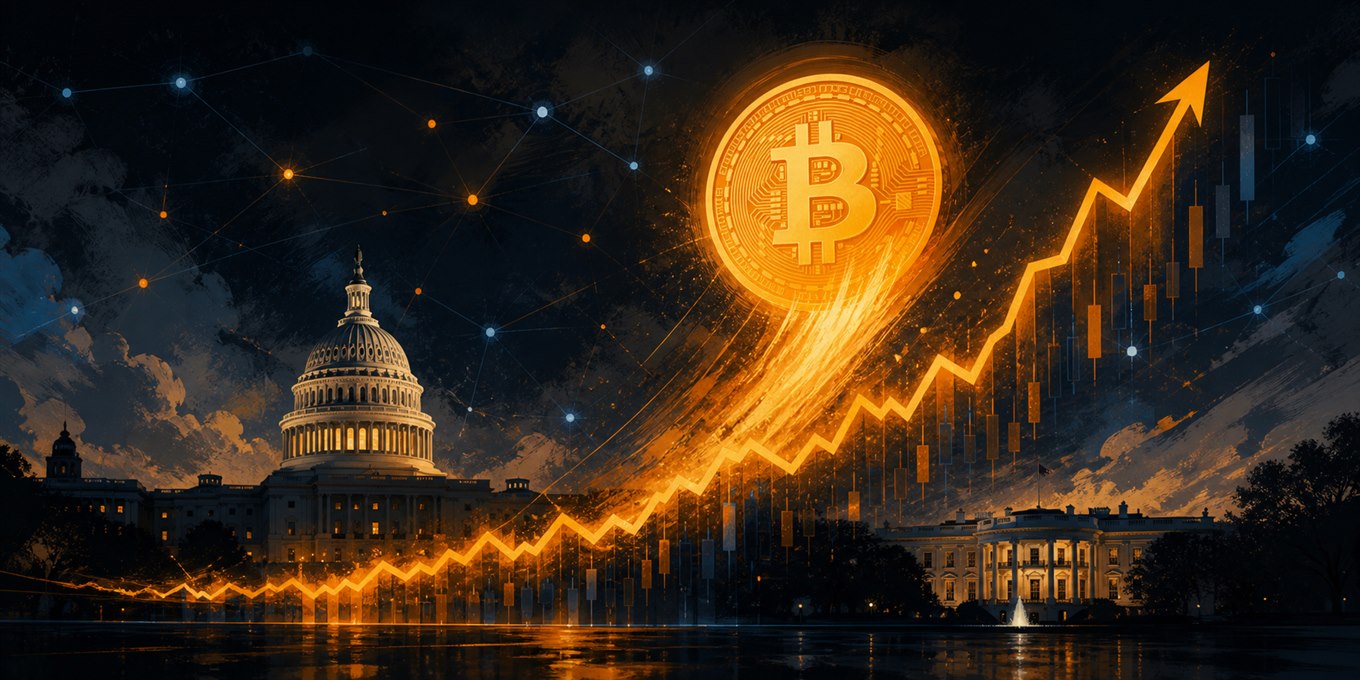
Bitcoin climbed toward $74,000 Thursday night, extending a two-day move that carried it out of the low-$60,000 range and back to levels not seen since early summer. The rally accelerated after President Donald Trump used a White House meeting with crypto executives to urge Congress to advance the stalled CLARITY Act.
The verified catalysts are substantial: a formal Senate step toward September debate, Trump’s public support, roughly $517 million in Wednesday net inflows reported across U.S. spot bitcoin ETFs, falling long-term Treasury yields and a violent short squeeze. Together they created the kind of thin-air repricing that happens when skeptical positioning meets a real policy headline.
Then the market added its own story. Social feeds began treating three separate claims as settled fact: that the CLARITY Act had already passed in private, that the White House was preparing a large open-market bitcoin purchase, and that the federal government had begun running a Bitcoin node. As of publication, none of those three claims has been confirmed by an official record.
What actually happened with the CLARITY Act
The bill did not pass behind closed doors. On August 8, Senate Majority Leader John Thune filed cloture on the motion to proceed to H.R. 3633, the Digital Asset Market Clarity Act. In plain English, Senate leadership started the process that can bring the bill to the floor. The Senate’s own record shows a motion to proceed and a cloture filing—not a final vote, not Senate passage and not a presidential signature.
That procedural move still matters. It gives the legislation a defined path when senators return from recess in September and tells markets that the bill is alive after weeks of stalemate. The House passed its version in 2025, but the Senate must still agree to take up the measure, resolve disputed provisions and pass text that can clear both chambers.
Trump raised the political temperature Wednesday. At the White House event, he called on Congress to take the next step on CLARITY while regulators described actions they could pursue under existing authority. The message was bullish for the industry. It was not a substitute for the votes the bill still needs.
The Strategic Bitcoin Reserve is real. New buying is not confirmed
The United States already has a Strategic Bitcoin Reserve. Trump created it by executive order in March 2025, capitalizing it with bitcoin forfeited to the government and directing agencies not to sell reserve assets except under narrowly defined circumstances.
The same order authorized Treasury and Commerce to evaluate “budget neutral” ways to acquire additional bitcoin. That language has kept purchase speculation alive for more than a year. It is meaningful authority, but it is not evidence that an order has been placed. No White House release, Treasury notice or federal filing reviewed for this article confirms a new open-market purchase.
This distinction matters because the rumor itself can move price. A government buyer would be competing for a fixed-supply asset while also conferring an extraordinary form of institutional legitimacy. Traders do not need the purchase to have happened before positioning for the possibility that it could.
What about the claim that Washington is running a Bitcoin node?
We found no official confirmation that the White House, Treasury or another named federal agency has launched a public Bitcoin full node as part of the reserve program. Agencies may operate private technical infrastructure that is not publicly documented, but absence of a denial is not confirmation.
A full node independently verifies transactions and blocks against Bitcoin’s consensus rules. It gives its operator direct, trust-minimized access to the ledger. It does not mine blocks, add meaningful hashpower or by itself “secure Bitcoin” in the military sense circulating online.
Still, the idea has strategic logic. A sovereign custodian holding a major bitcoin reserve should not have to trust an exchange or outside data provider to tell it which chain is valid. That is where the rumor intersects with Major Jason Lowery’s Softwar thesis: governments are beginning to ask whether Bitcoin infrastructure belongs in the same conversation as cyber resilience and critical networks. A node would be a sensible verification tool. It would not prove that Lowery’s broader power-projection framework had become U.S. policy.
Why the rally became so violent
Policy explains the spark. Positioning explains the speed. Bitcoin entered the week after months of weakness, repeated failures near resistance and heavy demand for downside protection. When price cleared those levels, short sellers were forced to buy bitcoin back into a rising market. That mechanical demand amplified genuine spot buying.
ETF flows added a second layer. More than half a billion dollars of reported net inflows on Wednesday suggested the move was not occurring only in offshore derivatives. Meanwhile, the Treasury’s decision to expand long-duration debt buybacks pushed yields lower and improved the broader backdrop for scarce, non-yielding assets.
The result was a feedback loop: policy optimism lifted spot demand, the breakout triggered liquidations, liquidations accelerated price, and the accelerating price gave unverified reserve and node rumors a larger audience.
What to watch next
The first test is whether Bitcoin can hold the breakout after forced buying subsides. A rally built partly on short liquidations can reverse quickly when that fuel is exhausted. Sustained ETF inflows would provide stronger evidence of durable demand.
The second test is documentary. Watch the Senate floor record for an actual cloture vote, the White House and Treasury for reserve implementation details, and named agencies for verifiable node infrastructure. Until those records appear, “CLARITY passed,” “the government bought bitcoin” and “Washington launched a node” belong in the rumor column.
BOTTOM LINE
Bitcoin’s rally has real foundations: White House advocacy, a Senate procedural step, ETF inflows, lower yields and a short squeeze. The most spectacular claims—passage, federal buying and a government node—remain unverified.
SOURCES & DATA

Marisol Vega
Bitcoin Almanack's editorial byline for Bitcoin markets, spot ETF flows, institutional activity, regulation, and daily news.