Seven weeks blind: what actually moves bitcoin before the Fed meets again
Yesterday's hold settles nothing until September 15–16. Between now and then, five scheduled events carry more weight than usual — starting with minutes that will finally say which way three governors actually voted.
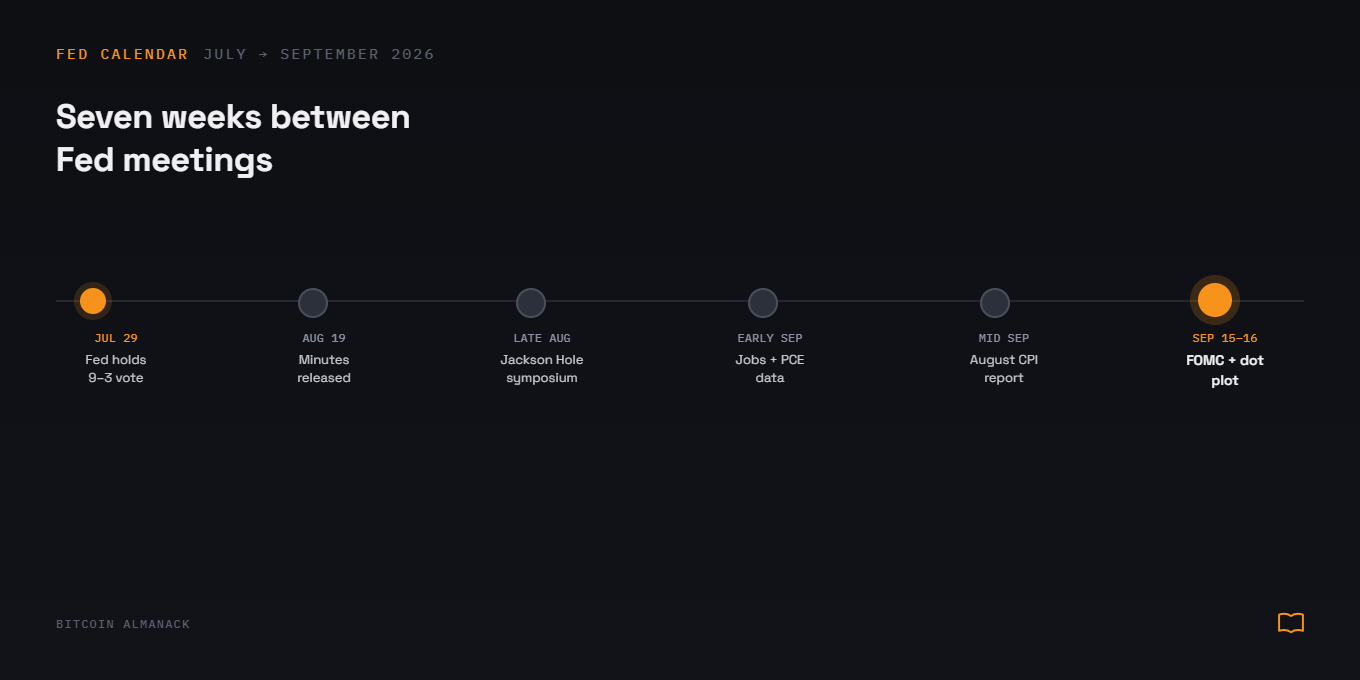
The five scheduled events between the July hold and the September 15\u201316 decision. Chart: Bitcoin Almanack.
Wednesday's Fed hold left the target range at 3.5%–3.75% on a 9–3 vote and told markets almost nothing about what comes next. The next scheduled decision is September 15–16 — seven weeks away, and the first meeting since the July split that will carry a Summary of Economic Projections, meaning it comes with the dot plot: the Committee's own chart of where each member expects rates to sit ahead. It will also be the first dot plot released under Fed Chair Kevin Warsh.
Seven weeks is a long gap to trade blind, but it isn't actually blind — a specific sequence of releases will shape whether September brings a cut, another hold, or a hike. None of them are the Fed speaking directly. All of them will move the odds market is pricing for what the Fed does next, and bitcoin has spent the last several months trading in step with exactly that repricing.
The first and most information-dense date is August 19, when the minutes from this week's meeting are released. The statement alone did not say which way the three dissenting votes leaned — toward a cut, a hike, or a split between the two. The minutes will. That single detail changes the entire read of how divided the Committee actually is, and by how much.
Days later comes the Fed's annual Jackson Hole symposium in late August, traditionally where a sitting chair gives the year's most-parsed policy speech. It will be Warsh's first as chair, and markets that have had five months to read his public statements will be listening for anything that updates the framework rather than restates it.
Behind those two events sits the ordinary data calendar: an August jobs report in early September, an August PCE inflation reading before that, and — landing just days ahead of the meeting itself — an August CPI report. CPI closest to the decision date has historically carried outsized weight precisely because it is the freshest inflation signal the Committee has before it votes, and inflation running above target was the specific tension the July statement named.
None of this changes the supply side of the bitcoin thesis. The halving schedule does not move on a Fed calendar. What it changes is the next seven weeks of noise — and noise is easier to sit through when you know what's generating it, rather than reacting to a chart that seems to move for no reason.
BITCOIN ALMANACK ANALYSIS
The calendar between now and September 15–16
WHEN
EVENT
WHY IT MOVES ODDS
Aug 19
July meeting minutes
Reveals which way the 3 dissents leaned
Late Aug
Jackson Hole symposium
Warsh's first policy speech as chair
Late Aug
August PCE inflation
The Fed's preferred inflation gauge
Early Sept
August jobs report
Tests the "solid economy" line in the July statement
Mid-Sept
August CPI report
Freshest inflation read before the vote
Sept 15–16
FOMC meeting + dot plot
Decision, plus first Warsh-era rate projections
Dates are the standard release cadence for each series; exact days are confirmed closer to publication · Table: Bitcoin Almanack
WHY IT MATTERS
Bitcoin does not need the Fed to move to feel it. Every print between now and September 15–16 will shift the market's odds of what the Committee does next, and those odds are what actually drive short-term positioning — including the ETF flows that increasingly set the weekly price tape. Knowing the calendar doesn't predict the outcome; it explains the noise.
What to watch next
1.August 19 minutes. The first hard data point on which way the three July dissents actually leaned — the single most consequential release before the meeting itself.
2.Jackson Hole. Chair Warsh's first symposium speech will be read line by line for any shift in framework, not just tone.
3.Whether ETF flows track the repricing. If odds shift toward a cut, watch whether inflows resume before the meeting confirms it — flows have been leading the decision, not following it.
4.Oil and the Middle East line. The July statement named this risk explicitly; a sustained move in crude changes the inflation math the Committee is weighing in September.
Frequently asked questions
When is the next Fed meeting?
September 15–16, 2026. It includes the Summary of Economic Projections — the dot plot — and will be the first one released since Kevin Warsh became Fed chair.
What happens between now and then?
Minutes from the July meeting land August 19 and reveal which way the three dissenters voted. Jackson Hole follows in the same window, then an August jobs report, PCE inflation reading, and an August CPI report in the final two weeks before the meeting.
Which of these matters most for bitcoin?
The CPI print closest to the meeting usually carries the most weight, since it's the freshest inflation read the Committee has before voting. The July minutes matter almost as much this cycle — they resolve information the statement didn't give.
Should investors change their approach before September?
For a long-term holder, no single data point in this window should change the plan. Tracking the calendar is about context, not timing — dollar-cost averaging exists so none of these dates require a trading decision.
SOURCES & DATA
Federal Reserve — FOMC meeting calendar and confirmed dates ↗
Federal Reserve — minutes release schedule ↗
Kansas City Fed — Jackson Hole Economic Symposium ↗
Bureau of Labor Statistics — CPI release schedule ↗
Meeting dates are the Federal Reserve's confirmed 2026 calendar; each is tentative until confirmed at the meeting immediately preceding it. Data release dates follow standard agency cadence and are estimates until each agency confirms its exact date. Directional readings are our analysis, not forecasts, and nothing here is investment advice — see our editorial process and corrections policy.

Marisol Vega
Markets & ETFs Reporter. Follows the flow ledger, the funds behind it, and the policy that shapes both.
MORE FROM THIS WEEK