Sixteen years of “I don’t have time to try to convince you”
Satoshi wrote it on 29 July 2010, at the end of a technical argument about scaling. It has since become bitcoin’s favourite way to avoid having one.
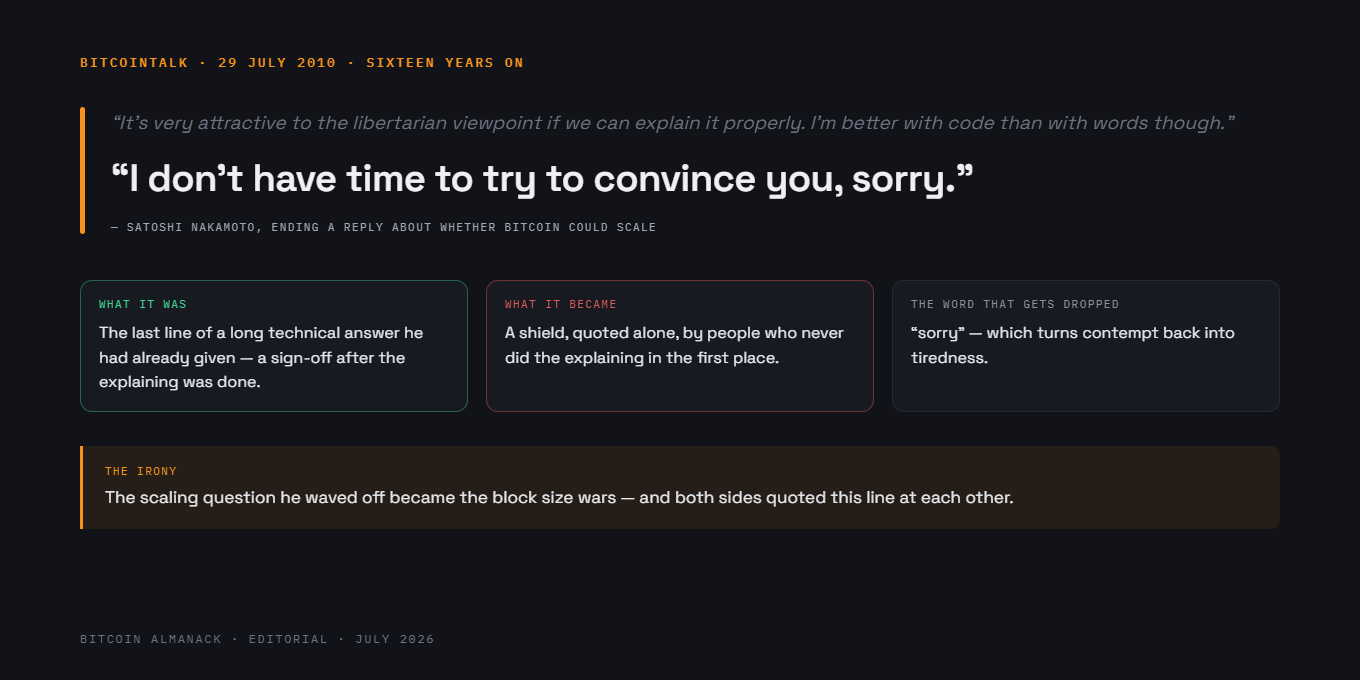
Sixteen years on, the line is quoted more often than the argument it ended.
“If you don’t believe me or don’t understand, I don’t have time to try to convince you, sorry.”
SATOSHI NAKAMOTO · BITCOINTALK · 29 JULY 2010
It is the most quoted sentence Satoshi ever wrote, and one of the least understood. Sixteen years ago today he typed it into a forum thread, and it now appears on t-shirts, in bios, and at the end of arguments its author was not having.
The context matters enormously. He was replying to a sceptic who insisted bitcoin could never handle real transaction volume — and he had already answered at length. He described how the load would fall to specialised hardware and server farms rather than ordinary machines, and made the point that most users would never need to run a full node at all. He compared it to how the internet worked in practice: the infrastructure gets industrial, the user experience stays simple.
Then, having laid all that out, he ended with the line. Read in place, it is not a refusal to explain. It is a man who has just spent several paragraphs explaining, declining to do it a second time for someone who did not want to hear it the first. The tone is tiredness, not contempt — and the “sorry” on the end, which almost never survives the quotation, does a lot of work.
How a sign-off became a shield
Stripped of the argument it closed, the sentence changes function entirely. Quoted alone it becomes thought-terminating: a way to answer “but how does the network stay secure when the subsidy shrinks?” or “what happens to fees at scale?” without engaging. The person deploying it usually has not done the explaining Satoshi did first, which is the whole difference.
That habit costs bitcoin something real. Every person who asks a sincere question and gets a shrug quoted at them is a person who concludes the answer does not exist. Some of those questions are excellent, and a few remain genuinely open. Treating curiosity as an attack is how a technical community becomes a closed one.
There is a second irony. The scaling question Satoshi was waving away did not go away — it became the defining fight of bitcoin’s next decade. The block size wars of 2015 to 2017 were fought over exactly the ground he had covered in that post, and both sides quoted him at each other. The line intended to end a scaling argument was later used to prosecute one.
Was he right?
Partly, and not in the way either camp claims. He was right that users would not all run full nodes, and right that hardware would specialise — today’s industrial mining operations are that prediction realised at a scale he probably did not picture. He was right that the base layer would carry more value per transaction than volume of them.
What he did not describe was layering. The network did not solve payments by making blocks big enough for everyone; it kept the base chain conservative and pushed everyday payments to systems like the Lightning Network. That was not in the 2010 post. It emerged from years of argument by people who did take the time to convince each other.
Which is the useful lesson on the anniversary. Bitcoin exists because a pseudonymous developer spent two years patiently answering questions on mailing lists and forums — and it survived because thousands of people carried on doing that after he left. The one sentence where he ran out of patience is not the instruction manual. It is the exception that proves how much explaining the rest of it took.
If you want the version of bitcoin culture worth keeping, it is not this line. It is the ten lessons before it — the ones that assume you deserve an answer.
WHY IT MATTERS
Quotes become doctrine when nobody checks the source. This one is a case study: a weary closing line, lifted out of a technical post, repurposed into permission not to explain bitcoin to anyone. Reading the original post takes four minutes and produces the opposite conclusion.
Frequently asked questions
What is the full quote?
“If you don’t believe me or don’t understand, I don’t have time to try to convince you, sorry.” Posted to Bitcointalk on 29 July 2010, closing a long technical reply about whether bitcoin could scale.
What was he actually talking about?
Scaling. He argued specialised hardware and server farms would carry transaction load and that ordinary users would not need to run full nodes. The line closed an argument he had already made at length.
Why is it controversial?
Because it gets used as a conversation-ender by people who have not done the explaining first. Quoted alone it reads as a shrug; in context it follows several paragraphs of patient technical detail.
Was Satoshi right about scaling?
Partly. Right that most users would not run nodes and that hardware would specialise. He did not describe the layered approach the network actually took — conservative base chain, payments on Lightning. The block size wars were fought over this exact ground.
SOURCES & DATA
Nakamoto Institute — complete archive of Satoshi’s Bitcointalk posts, searchable by date ↗
Bitcointalk — the original scalability thread ↗
Quotation and date taken from the archived forum post; read the surrounding thread rather than trusting any single line, including ours. Interpretation is the author’s opinion — see editorial standards and corrections policy.

Jason Viscosi
Founder and editor. Writes the opinion column and argues with the rest of the desk about it.