El Salvador's bitcoin bet, five years in: still buying, still mining volcanoes, still fighting the IMF over the count
The reserve has grown from 5,968 to more than 7,700 BTC since an IMF loan supposedly banned new purchases. Both sides call it consolidation. The blockchain doesn't take sides.
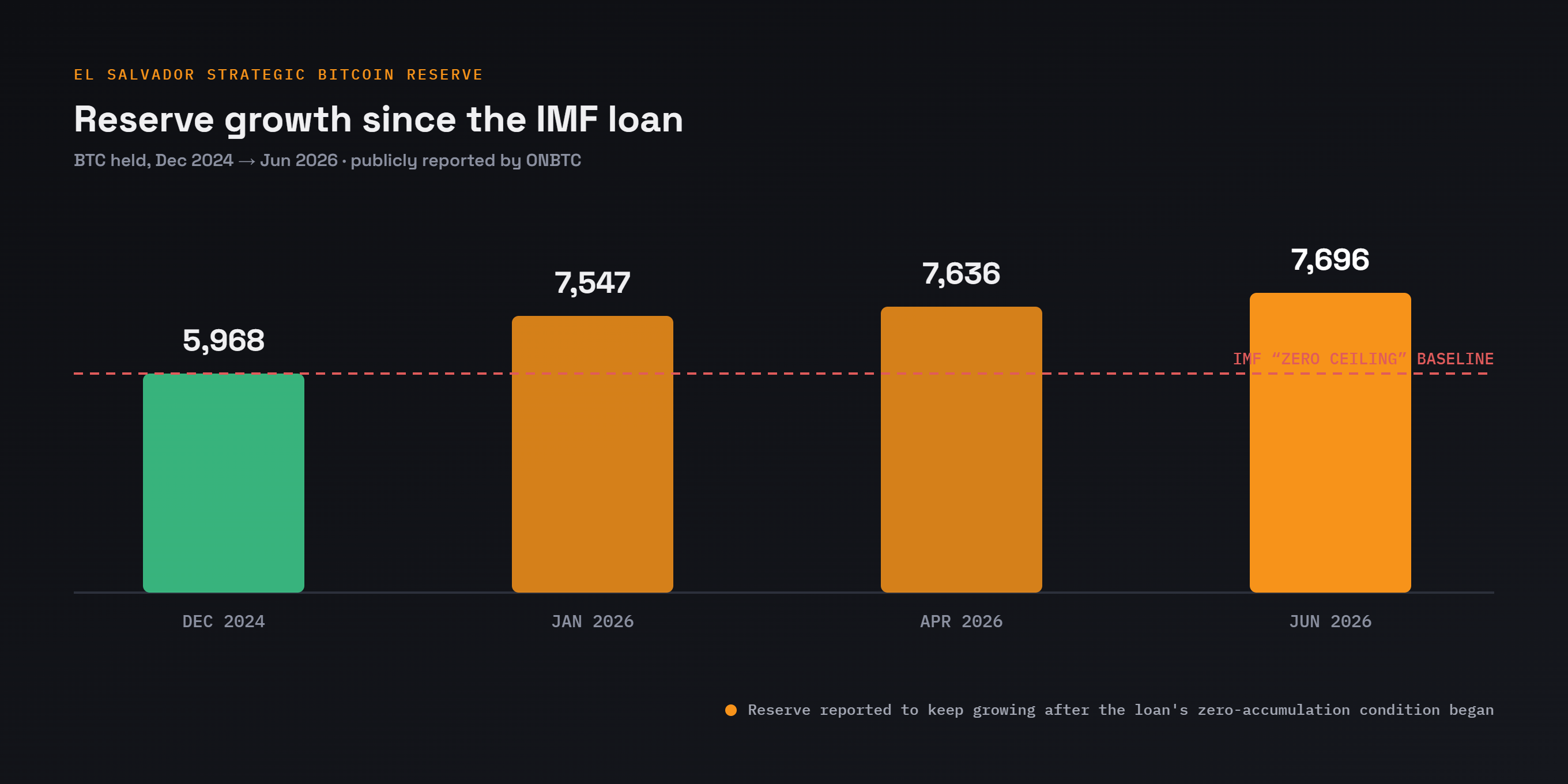
Reserve growth against bitcoin's price, and the point the IMF loan supposedly stopped it. Chart: Bitcoin Almanack.
Yes, it's still buying — on paper
El Salvador's National Bitcoin Office (ONBTC) has run a public one-bitcoin-a-day accumulation narrative since November 2022, and it has never stopped announcing purchases. The Strategic Bitcoin Reserve stood at 7,696 BTC as of late June 2026 — up from 5,968 BTC when a $1.4 billion IMF loan program formalized in December 2024. On the surface, that's straightforward continuity: a government that said it would buy bitcoin every day, still buying bitcoin every day.
Except the IMF's Extended Fund Facility, approved in February 2025, includes a continuous performance criterion — not a suggestion, a condition tied to loan disbursement — setting a hard zero ceiling on new voluntary bitcoin accumulation by the public sector. IMF spokesperson Julie Kozack has said since July 2025 that the reserve's growth reflects consolidation of coins across existing government-owned wallets, not net new market purchases. Salvadoran officials have disputed that characterization while continuing to publicize daily buys. Both governments have an incentive to let the ambiguity stand: El Salvador keeps its narrative and its loan; the IMF keeps the appearance of enforced conditionality.
The volcano program that started it
The mining side of the story is smaller and older than the DCA headline suggests. Since 2021, El Salvador has diverted about 1.5 megawatts from a state-owned geothermal plant tapping the Tecapa volcano to run roughly 300 mining machines. By mid-2024 that operation had mined about 474 BTC — worth around $29 million at the time — a modest but real example of a government mining its own reserve asset with domestic renewable power instead of buying it on the open market.
The bigger bet is Volcano Energy, a public-private partnership building wind, solar, and geothermal generation capacity specifically to fund large-scale mining, with Tether as an equity investor and advisor and Luxor Technology providing pool infrastructure through a joint venture known as Lava Pool. The approach is sequenced deliberately: solar and wind capacity comes online first to start monetizing sooner, while the project builds toward tapping El Salvador's volcanic geothermal resources at real scale. Bukele has floated extending the model further — a "rent your volcano" program that would let outside mining operations lease access to the country's geothermal capacity.
Is mining actually funding the daily buys?
Not in any clean, traceable sense. Bukele has said publicly that accumulation comes from a mix of sources — mining output, passport sales, currency conversion services, and other government revenue — not from mining proceeds alone funding a literal daily purchase. The Tecapa operation's 474 BTC over roughly three years is a rounding error next to the more than 1,700 BTC the reserve added between December 2024 and June 2026 alone. Whatever is driving the reserve's growth now, it isn't primarily volcano-mined coins.
Has the bear market changed anything?
No, at least not the headline policy. Bitcoin has fallen roughly 19% over recent weeks and traded down into the high $50,000s to low $60,000s through late June 2026, pulling the reserve's value down from a peak near $800 million earlier in the year to somewhere around $450–480 million depending on the day counted. El Salvador has not sold a single coin from the treasury. That's a meaningfully different posture than Strategy's, the largest corporate holder, which began selling small amounts of bitcoin in June 2026 to cover cash needs — a sovereign reserve, insulated from shareholder redemptions and quarterly earnings pressure, can absorb a drawdown that a public company's capital structure cannot.
Where the legal-tender rollback fits in
None of this happened in isolation. As a condition of the same IMF loan, El Salvador's Legislative Assembly amended the 2021 Bitcoin Law in February 2025: merchant acceptance became voluntary rather than mandatory, taxes became payable only in dollars, and the government began winding down the Chivo wallet that had been the original law's centerpiece. Bitcoin's role as an accepted currency has receded even as the treasury position has not — the reserve and the legal-tender experiment turned out to be two separable bets, and only one of them survived the IMF negotiation intact.
BITCOIN ALMANACK ANALYSIS
The reserve since the IMF deal
DATE
RESERVE
EVENT
Dec 2024
5,968 BTC
IMF EFF formalized; zero-ceiling condition begins
Jan 2026
7,547 BTC
Reserve value near $635M peak-adjacent
Apr 2026
7,636 BTC
ONBTC keeps publicizing daily buys
Jun 2026
7,696 BTC
~$460M; BTC down ~19% in 30 days
Figures as publicly reported by ONBTC and tracked by BitcoinTreasuries/CoinGecko; the IMF disputes that the increase reflects new purchases · Table: Bitcoin Almanack
WHY IT MATTERS
El Salvador is the live test case for whether a sovereign can hold — and keep growing — a bitcoin treasury while inside an active IMF program, so long as headline macro targets stay on track. Its remittance pitch has mostly failed: crypto-linked remittances were $17.38 million against $2.43 billion in total transfers in Q1 2026, well under 1%. But the treasury bet has survived a policy rollback, a bear market, and a direct dispute with its own lender — which is the part other governments weighing sovereign bitcoin reserves are actually watching.
What to watch next
1.The next IMF program review. If a review can't reconcile the rising on-chain balance with the "wallet consolidation" explanation, the $1.4B facility's disbursements are the leverage point.
2.The 20,000 BTC target. Chief bitcoin advisor Max Keiser has said the country aims to nearly triple its holdings — a target that would force an explicit renegotiation with the IMF rather than a quiet one.
3.Volcano Energy's build-out. Whether the wind/solar-first phase actually converts into large-scale geothermal mining capacity, and whether Bukele's "rent your volcano" idea becomes a real program.
4.Whether remittance adoption ever moves. The original case for the 2021 law was cheaper remittances; five years on, that number is still under 1% of total flows.
Frequently asked questions
Is El Salvador still buying bitcoin?
The National Bitcoin Office says yes, publicly announcing purchases on most days. The IMF says the reserve's growth reflects consolidation of coins across existing government wallets, not new market purchases funded by the public sector, which its loan program bars. The two accounts do not fully reconcile.
Is the volcano mining program funding the daily purchases?
Not directly or exclusively. Bukele has said accumulation comes from a mix of mining output, passport sales, currency conversion, and government services, not from mining revenue alone. The original Tecapa volcano operation mined roughly 474 BTC over about three years — a small fraction of the reserve's growth.
Has El Salvador sold any of its bitcoin?
No. Despite a 2026 price drawdown that has cut the reserve's value from a peak near $800 million to roughly $450–480 million, the government has not sold any bitcoin from the Strategic Bitcoin Reserve.
Is bitcoin still legal tender in El Salvador?
No — mandatory legal tender status was repealed in February 2025 as an IMF loan condition. Merchant acceptance is now voluntary, taxes are payable only in dollars, and bitcoin can still be used as a currency by anyone who chooses to.
SOURCES & DATA
IMF — El Salvador Extended Fund Facility program documents ↗
Bitcoin Magazine — five years of El Salvador's bitcoin law ↗
Bitcoin.com News — reserve accumulation through the 2026 drawdown ↗
Reserve figures are as publicly reported by El Salvador's National Bitcoin Office and tracked by third-party services; the IMF's characterization of reserve growth is disputed by Salvadoran officials. Not investment advice — see our editorial process and corrections policy.

Marisol Vega
Markets Reporter covering bitcoin ETFs, sovereign treasuries, and daily news. Tracking every spot ETF flow report since the funds launched in January 2024.
MORE FROM THIS WEEK
Inside Volcano Energy: El Salvador's $1 billion bet on turning volcanoes into a bitcoin mining giant
MINING
Seven weeks blind: what actually moves bitcoin before the Fed meets again
MARKETS
The Fed holds, three governors dissent, and bitcoin gets the answer it least wanted
MARKETS
Three green weeks, seven percent recovered: where ETF flows actually stand
MARKETS