Inside Volcano Energy: El Salvador's $1 billion bet on turning volcanoes into a bitcoin mining giant
A 241-megawatt solar-and-wind park is phase one of a plan that claims it could scale to 20,000 megawatts. Here's what's actually been built, and how it differs from the original volcano mining program.
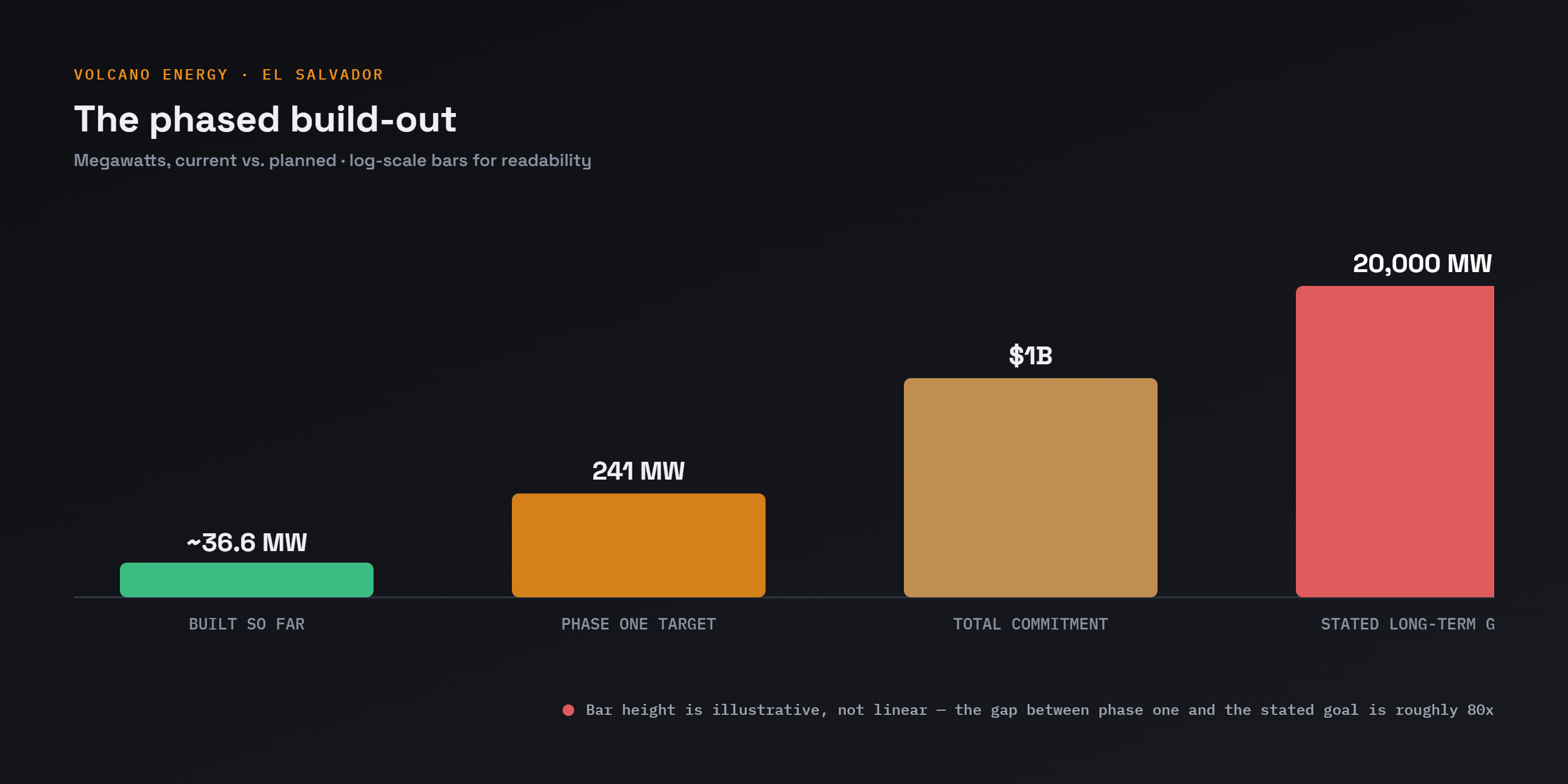
Volcano Energy's phased build-out, from the 241MW solar-and-wind park to the long-term geothermal target. Chart: Bitcoin Almanack.
Two separate volcano programs, often confused
El Salvador has run a modest government geothermal mining operation since 2021, diverting 1.5 megawatts from a state-owned power plant at the Tecapa volcano to roughly 300 machines. That project has mined about 474 BTC — worth around $29 million — over its lifetime. It's real, but small: 1.5MW out of a facility producing over 100MW.
Volcano Energy is a different, far larger animal. It's a public-private partnership founded by Salvadoran entrepreneur Josué López, with Max Keiser — an advisor to President Bukele — as chairman. Tether is an equity investor and advisor through CTO Paolo Ardoino, and the venture has committed to routing 23% of its net revenue back to the Salvadoran government. The plan: build renewable generation capacity specifically to fund bitcoin mining at a scale the government's own program never attempted.
The plan: solar and wind first, geothermal eventually
Phase one is a 241-megawatt renewable park in Metapán, in the El Shiste hamlet of Santa Ana department — chosen for strong solar and wind yield, not for volcanic activity. It splits into 169MW of photovoltaic solar and 72MW of wind, backed by a total funding commitment of $1 billion, with $250 million committed to get the first phase built. The sequencing is deliberate: solar and wind can be permitted and built faster than geothermal, letting the project start generating mining revenue sooner while the company works toward its stated long-term ambition of scaling to as much as 20,000 megawatts — a target that would dwarf the current park by roughly two orders of magnitude, and that Volcano Energy itself has framed as a multi-phase, multi-year trajectory rather than a near-term commitment.
The mining side runs through Lava Pool, a joint venture with Luxor Technology launched in October 2023 — El Salvador's first domestically based mining pool. Luxor supplies pool infrastructure and its Hashrate Forward Marketplace, a hedging tool miners use to lock in revenue against bitcoin's price swings. At launch, Volcano Energy projected the pool's initial hashrate would exceed 1.3 EH/s, which would have placed it among the world's twenty largest pools.
Where construction actually stands
Volcano Energy's own public figures put construction at more than 18,000 foundation piles driven and over 50,000 solar panels installed, with capacity reported above 36,600 kilowatts-peak — roughly 36.6 megawatts. That's real, physical progress, and it's also a fraction of the 169MW solar target inside phase one, which is itself a fraction of the 241MW first phase, which is itself roughly 1% of the eventual 20,000MW ambition. None of that makes the smaller number meaningless — utility-scale solar builds in stages, and tens of thousands of panels is not a paper announcement — but the gap between "under construction" and "20 gigawatts" is the entire story of how far this project still has to go.
BITCOIN ALMANACK ANALYSIS
The two volcano programs, compared
TECAPA (GOVERNMENT)
VOLCANO ENERGY (PRIVATE)
Launched
2021
2023
Power source
1.5MW of geothermal (Tecapa)
Solar + wind first, geothermal later
Scale target
Fixed at 1.5MW, ~300 machines
241MW phase one; up to 20,000MW stated ambition
Output so far
~474 BTC mined (through 2024)
~36.6MW under construction; pool live since 2023
Figures as publicly reported by El Salvador's Bitcoin Office and Volcano Energy · Table: Bitcoin Almanack
WHY IT MATTERS
Volcano Energy is a test of whether a small country can turn cheap renewable power into a durable bitcoin-mining industry rather than a single government pilot project. If it scales anywhere close to its stated ambitions, it would meaningfully diversify where the network's hashrate lives, away from the concentration in the US and a handful of other jurisdictions. If it stalls at tens of megawatts, it becomes a cautionary tale about the gap between renewable-energy press releases and gigawatt-scale execution.
What to watch next
1.Whether phase one's 241MW actually gets completed. Construction updates on panel counts and piles are progress markers, not a finished facility.
2.Any move toward the geothermal phase. The solar-and-wind sequencing was explicitly a bridge to tapping El Salvador's volcanic resources directly — that's the phase that would differentiate this from any other solar mining farm.
3.Lava Pool's actual hashrate share. The 1.3 EH/s figure was a launch-day projection; whether the pool sustained a top-20 ranking is a separate, checkable claim.
4.Bukele's "rent your volcano" idea. If it becomes a real program, it would open the country's geothermal capacity to outside mining operations beyond Volcano Energy itself.
Frequently asked questions
What is Volcano Energy?
A Salvadoran public-private partnership building renewable power capacity — starting with solar and wind, eventually geothermal — specifically to fund large-scale bitcoin mining. Tether is an equity investor and advisor; Luxor Technology provides mining-pool infrastructure through a joint venture called Lava Pool.
How big is Volcano Energy's mining operation right now?
The first phase targets 241 megawatts (169MW solar, 72MW wind) in Metapán. Construction progress reported by the company includes more than 18,000 foundation piles and 50,000 solar panels installed, with capacity so far above 36,600 kilowatts-peak — a fraction of the full first-phase target, let alone the long-term 20,000MW ambition.
Is Volcano Energy the same as El Salvador's original volcano mining program?
No. The original program, running since 2021, diverts 1.5MW from a state-owned geothermal plant at the Tecapa volcano to about 300 mining machines and has mined roughly 474 BTC. Volcano Energy is a separate, much larger private venture aiming for gigawatt-scale capacity, sequenced to start with solar and wind before eventually tapping geothermal resources directly.
SOURCES & DATA
Volcano Energy — official project figures and construction updates ↗
Bitcoin Magazine — Lava Pool launch coverage ↗
PaymentsJournal — the original Tecapa geothermal mining program ↗
Construction and capacity figures as self-reported by Volcano Energy; not independently audited. Not investment advice — see our editorial process and corrections policy.

Aisha Bennett
Mining Reporter covering hardware, hashrate, and the energy side of bitcoin.