Bitaxe Gamma Review (2026): The $61 Lottery Ticket That Teaches
OUR VERDICT
THE GATEWAY
8.5/10
Judge the Gamma as an investment and it fails on arithmetic: pennies a day, a payback period measured in decades. Judge it as what it actually is — a $61 board running the same BM1370 chip as an industrial S21 Pro, at the same efficiency, quietly on your desk for $1.56 a month — and nothing else in bitcoin hardware comes close. It is the cheapest way to hold a real, non-expiring claim on 3.125 BTC and to learn how mining works by doing it.
Independence note: Solo Satoshi is an affiliate partner and sells this device — we may earn a commission if you buy through our links. They had no input into this review, no advance copy, and no ability to change the score, and no commission arrangement changes what we publish. Specification and bench figures below are theirs, published and attributed as such; the judgements are ours. See how we review.
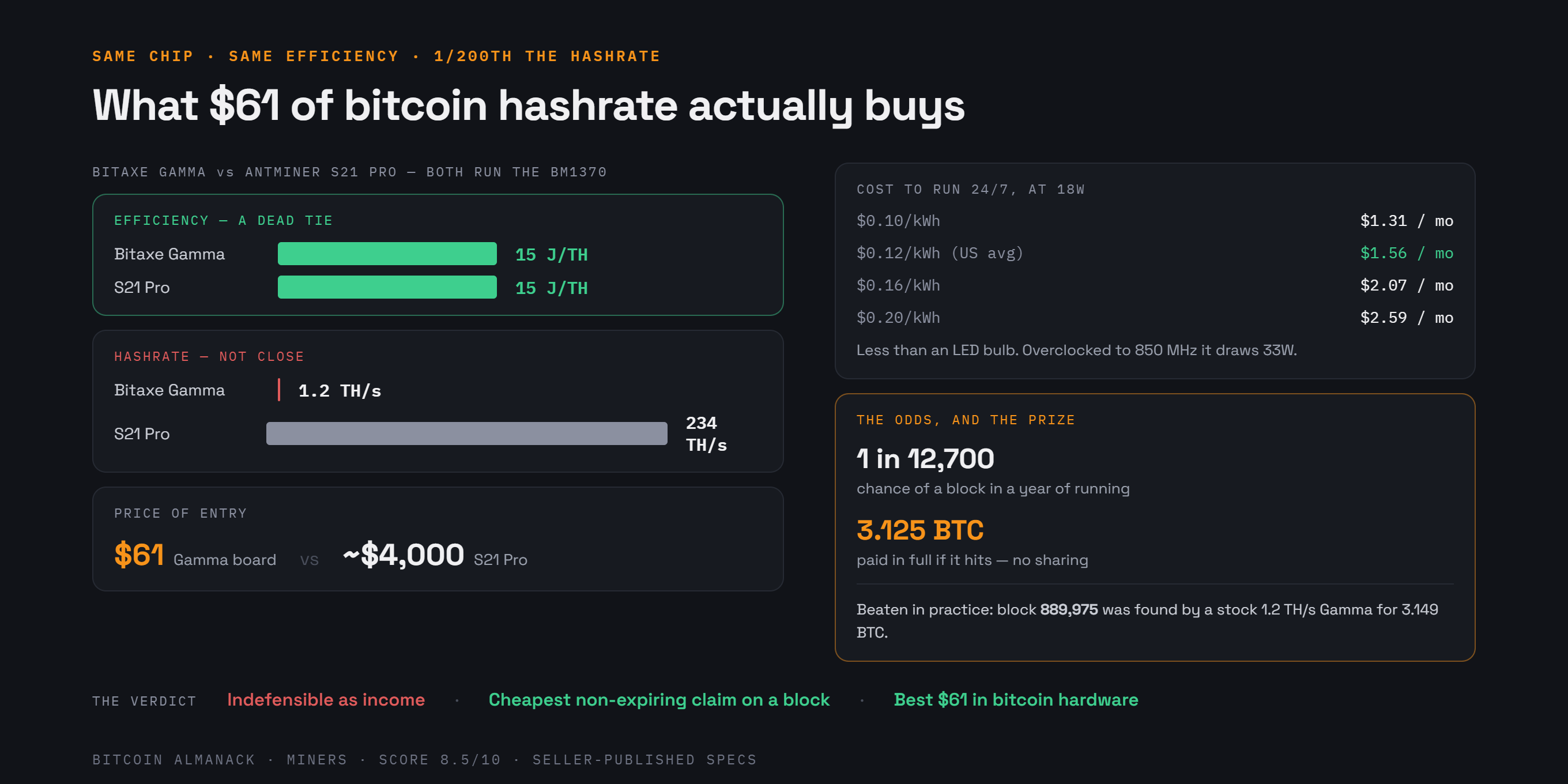
What $61 of hashrate buys against the network, and what it costs to run. Chart: Bitcoin Almanack.
The Bitaxe Gamma is a single-chip, open-source bitcoin miner about the size of a paperback — four inches by two and a quarter, three quarters of a pound. It produces 1.2 TH/s while drawing 18W, which works out to 15 J/TH. That last number is the interesting one, because it is the same efficiency figure as the Antminer S21 Pro, a machine that costs seventy times more.
That is not a coincidence. The Gamma runs a Bitmain BM1370 — the identical 5nm ASIC used in the S21 Pro. Bitmain does not sell the chip on its own, so most Bitaxe boards are built with chips harvested from S21 Pro hashboards. What you are buying is one industrial-grade chip on a community-designed board, instead of the two hundred-odd chips a full S21 Pro carries. Per joule you are level with a data centre. In absolute terms you have roughly one two-hundredth of its hashrate.
That ratio is the whole review. Everything good about this device and everything disappointing about it follows from being efficient and tiny at the same time.
The arithmetic, stated plainly
Point a Gamma at a conventional pool and it earns on the order of $0.05–0.06 per day per terahash before fees — call it a dollar and a half to two dollars a month. Electricity at the US average of $0.12/kWh costs about $1.56 a month for 18W running continuously. You are roughly break-even, and the payback on the hardware is measured in decades. Anyone selling this as passive income is selling you something else.
Solo mining changes the shape of the outcome, not its expected value. Configured against a solo pool, the Gamma's odds of finding a block are about 1 in 4.6 million on any given day, or roughly 1 in 12,700 across a year of continuous running. If it hits, the full 3.125 BTC block reward plus fees lands in your wallet — currently around $200,000. If it does not, you get nothing but the sats you did not earn.
Those odds have been beaten, which is what separates this from a scratch card. Block 889,975 in March 2025 was found by a stock 1.2 TH/s Bitaxe Gamma and paid 3.149 BTC. Block 887,212, in March 2025 as well, was found by a 480 GH/s unit — less than half a Gamma — and was worth about $258,000 at the time. Block 853,742 went to a ~500 GH/s Bitaxe in July 2024. The reason this is possible at all is that every hash is an independent attempt: your first guess has exactly the same chance of being right as any guess an S21 makes. The industrial miner simply makes vastly more of them.
Living with it
Setup is genuinely five minutes. Power it over the 5V barrel jack, join the
Bitaxe_XXXX broadcast network from your phone, hand it your Wi-Fi credentials, then open the AxeOS dashboard at the IP shown on the little OLED and paste in a bitcoin address. Two caveats worth knowing before you order: the ESP32-S3 radio is 2.4 GHz only — a 5 GHz-only network will stop you dead — and there is no Ethernet port on standard boards.Noise is around 35–40 dB with the pin-fin heatsink, which in practice means you stop noticing it. Multiple owner reports describe running one on a desk for days before a spouse realised it was on. That matters more than it sounds: this is the only class of mining hardware you can actually keep in a living space, which is the difference between a hobby you engage with and a machine exiled to a garage.
It overclocks well and the returns are real, but they cost efficiency. Stock 525 MHz gives 1.07 TH/s at 17.8W and 49°C. At 600 MHz you get 1.22 TH/s for 20.1W — the sweet spot, and where most owners settle. Push to 800 MHz and it is 1.63 TH/s at 32.2W: 36% more hashrate for 60% more power, and you now need a 50W supply and MOSFET heatsinks. Unit-to-unit variance runs about ±10% on silicon lottery alone, so treat any specific number you read online, including ours, as a range.
The one hard rule: it takes 5V. Fitting a 12V supply destroys the board. Several owner reports also mention re-doing the thermal paste on arrival to fix high ASIC temperatures, which is a five-minute job but not one a first-time buyer expects.
Where it sits against the alternatives
Against a real miner there is no contest on output — an Antminer S21 XP does 270 TH/s and will actually pay you, if you have the power contract, the space and the tolerance for the noise. Against other small miners, the Gamma is the efficiency leader among single-chip boards; the Bitaxe GT roughly doubles hashrate with two BM1370s, and multi-chip units go further again. If your goal is odds rather than education, buying two Gammas doubles your chances linearly and is usually the better spend than overclocking one to its limit.
Sourcing matters more here than with industrial hardware, because the Bitaxe is an open design that anyone can build. Cheap listings on general marketplaces have been flooded with clone boards carrying lower-bin chips and inadequate supplies. Buy from a seller recognised by the bitaxe.org project, with a warranty and a support address that answers.
WHAT WE LIKE
+S21 Pro efficiency (15 J/TH) in a palm-sized board
+$1.31–$1.56 a month to run at typical US rates
+Quiet enough for a desk at 35–40 dB
+Fully open hardware and firmware; repairable, moddable
+Five-minute setup, no computer required
WHAT WE DON'T
−Indefensible as income — decades to pay back
−2.4 GHz Wi-Fi only, no Ethernet option
−±10% unit variance; some need thermal paste redone
−Serious overclocks need a new PSU and heatsinks
−Clone boards are common outside verified sellers
Specifications
Specifications as published by Solo Satoshi, July 2026.
BENCH FIGURES — SELLER-PUBLISHED
Hashrate against power, by frequency
FREQUENCY
VOLTS
TEMP
HASHRATE
POWER
525 MHz (stock)
1150 mV
49°C
1.07 TH/s
17.8W
600 MHz
1150 mV
51°C
1.22 TH/s
20.1W
700 MHz
1250 mV
59°C
1.43 TH/s
28.4W
800 MHz
1250 mV
62°C
1.63 TH/s
32.2W
850 MHz
1250 mV
62°C
1.73 TH/s
33.0W
Solo Satoshi bench at 21°C ambient with pin-fin heatsink · 700 MHz+ needs a 50W PSU; 800 MHz+ needs MOSFET heatsinks · ±10% variance · We have not independently reproduced these figures
BUY IT IF
You want to understand mining by running it, you like the idea of a non-expiring claim on a block for the price of a year of lottery tickets, or you want real hashrate pointed at the network from a house rather than a data centre.
SKIP IT IF
You need the money back. If your goal is accumulating bitcoin, $61 into dollar-cost averaging beats $61 of hashrate on every honest model. Buy this with the entertainment budget, not the investment one.
Frequently asked questions
Is the Bitaxe Gamma profitable?
Not as income. Roughly $0.05–0.06/day per terahash on a pool before fees, against about $1.56/month in power at the US average rate — pennies a day, decades to pay back. It makes sense as a lottery ticket, a teaching tool and a contribution to decentralised hashrate, not as an investment.
What are the odds it finds a block?
About 1 in 4.6 million per day, or 1 in 12,700 over a year of running. Beaten in practice: block 889,975 (March 2025) was found by a stock 1.2 TH/s Gamma for 3.149 BTC, and block 887,212 by a 480 GH/s unit worth about $258,000.
How much electricity does it use?
18W at stock — less than an LED bulb. Running 24/7 that is about $1.31/month at $0.10/kWh and $1.56 at $0.12/kWh. An aggressive overclock roughly doubles it to around 33W.
Can you overclock it?
Yes — 1.07 TH/s stock up to 1.73 TH/s at 850 MHz. Past 700 MHz you need a 50W supply and MOSFET heatsinks; keep the ASIC under 65°C. Never fit a 12V supply to the 5V input.
Is it really the same chip as an Antminer?
Yes, the BM1370 from the S21 Pro. Bitmain doesn't sell it separately, so most boards use chips harvested from S21 Pro hashboards — which is why a $61 device matches an industrial miner on joules per terahash while producing about 1/200th of the hashrate.
SOURCES & DATA
Solo Satoshi — Bitaxe Gamma specifications, bench table, pricing and 215 buyer reviews ↗
bitaxeorg/ESP-Miner — AxeOS firmware source and releases ↗
mempool.space — block 889,975, verify the Bitaxe block win on-chain ↗
Open Source Miners United — the community behind the Bitaxe design ↗
Performance and running-cost figures are the seller's published bench numbers, not independently reproduced by us; expect ±10% unit variance. Block-reward values converted at prevailing spot. Affiliate links marked. Not investment advice — see our editorial process and corrections policy.

Aisha Bennett
Mining & Hardware Reporter. Tests ASICs, tracks hashprice, and reads power contracts so you do not have to.